
A few buckets of decorative stone can turn into a serious load faster than most people expect. To haul landscaping rock safely, start by treating rock like the dense, shifting cargo it is – not like a pile of yard waste. The right trailer, an honest weight estimate, and a careful load plan keep a weekend landscape project from becoming a damaged truck, broken trailer, or roadside problem.
Whether you are bringing home gravel for a driveway in Cottonwood, boulders for a Sedona yard, or crushed rock for a contractor job, the goal is simple: get it there without overloading your equipment or taking chances on the road.
Start With the Real Weight of the Rock
Rock is sold by the yard, by the ton, or sometimes by the scoop. Those measurements are not interchangeable, and guessing is where trouble starts. One cubic yard of common landscape rock can weigh roughly 2,000 to 3,000 pounds depending on the material, moisture, and stone size. Decomposed granite, river rock, crushed granite, and wet gravel all weigh differently.
Before loading, ask the supplier what the material weighs per cubic yard or per ton. Then compare that number with three limits: your truck’s towing capacity, the trailer’s gross vehicle weight rating, and the trailer’s payload capacity. Payload is what matters for the rock itself. It is the trailer’s maximum loaded weight minus the empty weight of the trailer.
Do not assume a larger-looking trailer can carry any amount of material. Trailer size and trailer capacity are different things. A trailer bed may have plenty of room for several yards of gravel but still be rated for less weight than that load creates.
If the numbers are close, make two trips. It may feel less efficient, but it is cheaper than wearing out brakes, damaging tires, bending an axle, or losing control on a downhill grade. In the Verde Valley, elevation changes and winding roads make a conservative load especially worthwhile.
Choose a Trailer Built for the Load
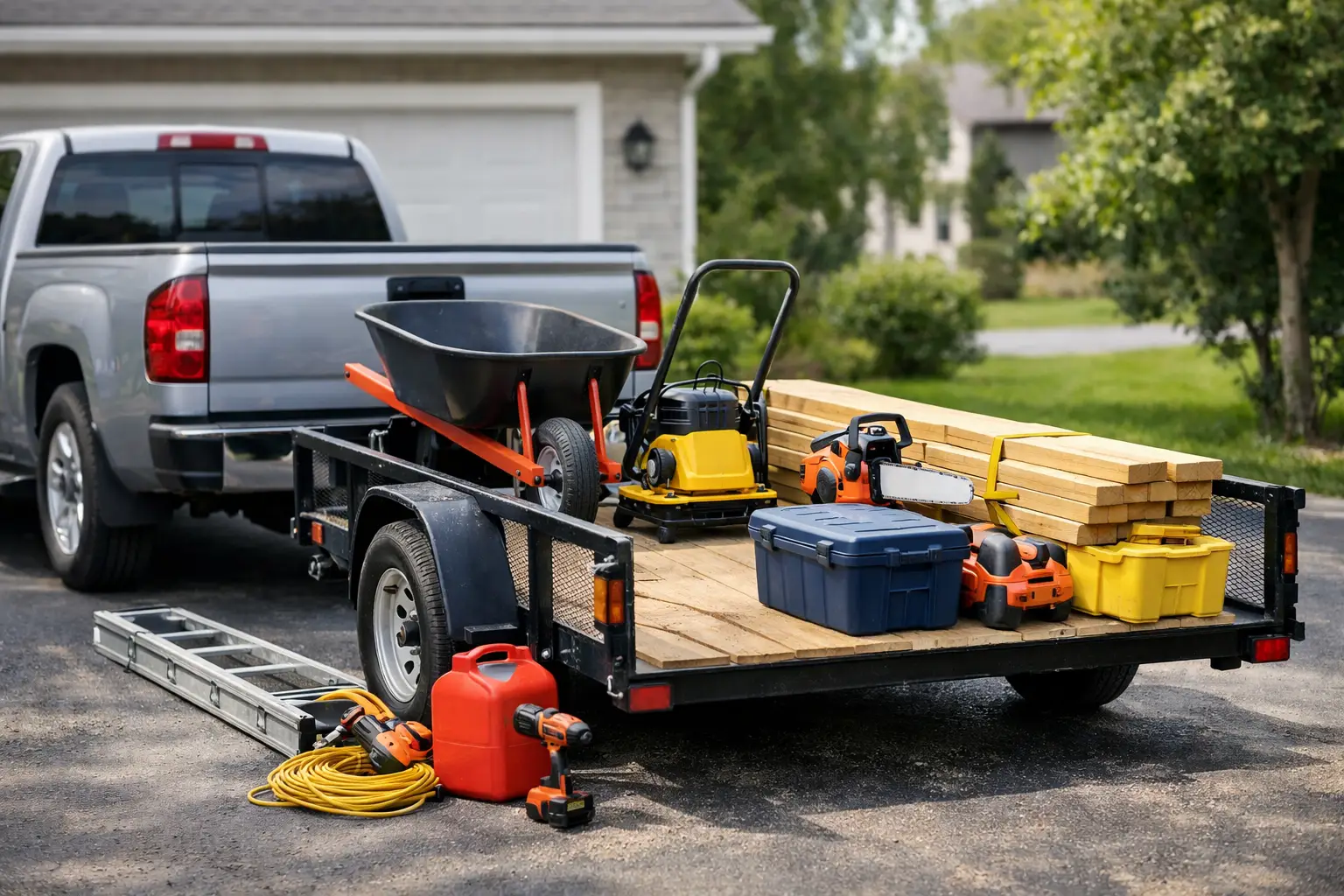
For loose rock, a dump trailer is often the most practical choice because it contains the material and makes unloading far easier. A utility trailer can work for bagged landscape rock or small, contained loads, provided it has solid sides, a sound floor, and enough rated capacity. An open car hauler is generally not the right tool for loose gravel or rock because it lacks the containment needed for bulk material.
The truck matters just as much as the trailer. Check the receiver hitch rating, ball mount rating, hitch ball size, tire condition, and vehicle towing limit. Your lowest-rated component sets the safe limit. A heavy-duty trailer does not make an undersized tow vehicle capable of handling a heavy load.
Make sure the trailer brake system is working when the trailer requires brakes. Connect the breakaway cable correctly to the tow vehicle – not looped around the hitch ball or safety chains. Plug in the trailer connector and test running lights, brake lights, turn signals, and electric brakes before you leave the loading area.
Load Landscaping Rock for Balance and Control
A properly loaded trailer should place roughly 10% to 15% of the total loaded trailer weight on the hitch. This is called tongue weight. Too little tongue weight can cause trailer sway. Too much can overload the rear of the tow vehicle, make steering feel light, and reduce braking control.
For loose material, have the loader place the bulk of the rock slightly ahead of the trailer axle or axle group. Do not pile it at the very front, and do not let the supplier dump the full load behind the axles. If the trailer squats hard at the rear of your truck or the front of the truck rises, stop and redistribute before driving away.
Bagged rock gives you more control over placement, but it still needs to be balanced. Load the heaviest bags low and centered, building the load evenly from front to back. Avoid stacking bags high enough that they can shift or fall during a sudden stop.
Before leaving, walk around the combination and look at it from the side. The trailer should sit reasonably level. A slightly nose-down stance is usually better than nose-high, but a sharply angled trailer can affect handling, clearance, and braking.
Secure the Load Before It Can Move
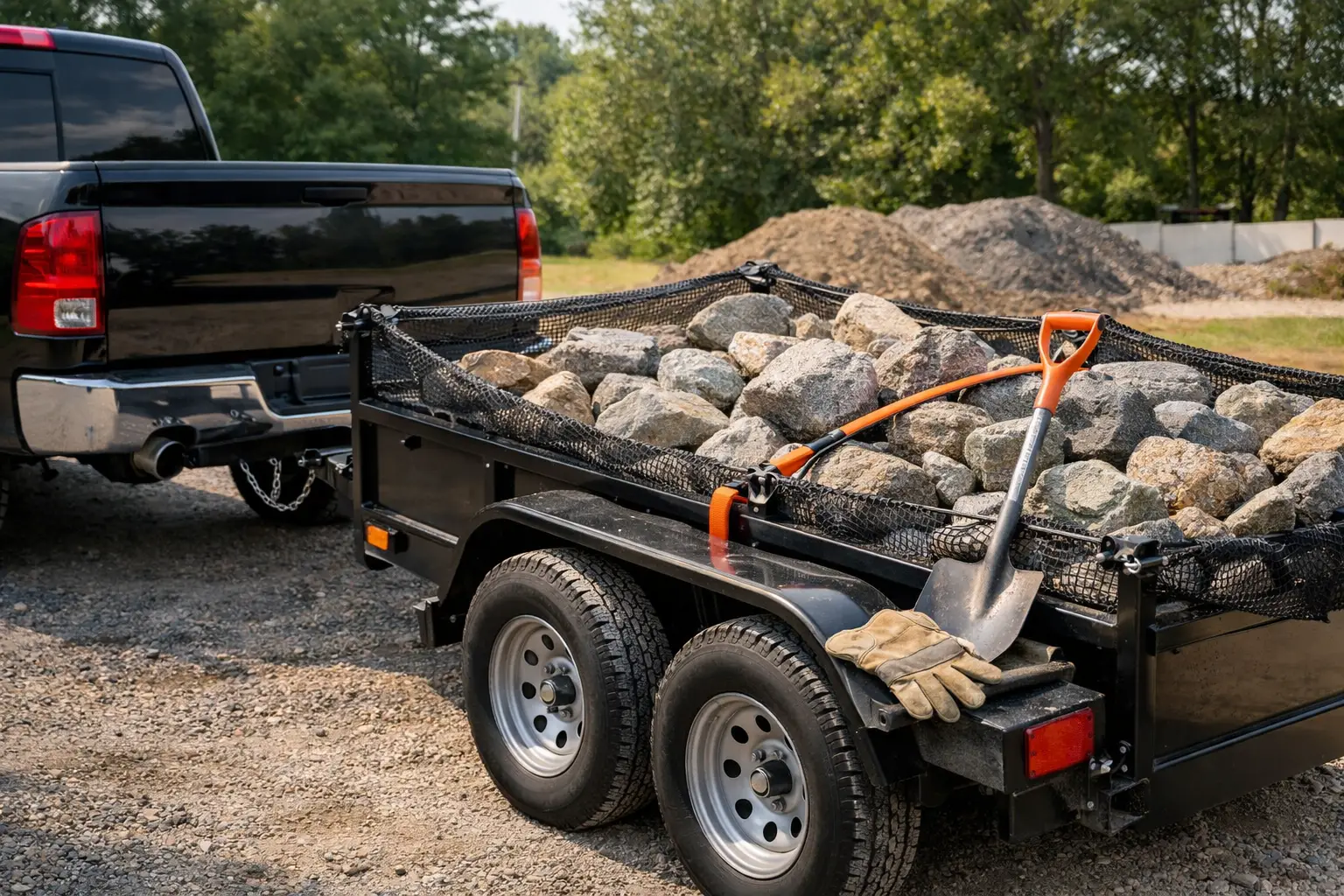
Loose rock may seem like it cannot go anywhere, but road vibration and wind can scatter small stones out of an open trailer. A tarp is a basic safety step and may also be required where you are traveling. Use a tarp that fully covers the load and secure it at multiple points so it cannot balloon or tear loose.
Bagged rock, boulders, and landscaping blocks need more than a tarp. Use appropriately rated straps or chains, and attach them to proper trailer tie-down points. Cross-strapping can help control side-to-side movement for irregular items. Protect straps from sharp rock edges with corner protectors or another suitable barrier.
Take a minute to check these items before pulling out:
- Coupler fully seated and locked on the correct hitch ball
- Safety chains crossed under the tongue with enough room for turns
- Breakaway cable attached directly to the tow vehicle
- Trailer lights and brakes tested
- Tires properly inflated and free of visible damage
- Rock balanced, contained, tarped, and secured
That inspection takes less time than dealing with a load shift on the road.
Drive Like You Are Carrying a Heavy Load
A loaded trailer changes acceleration, turning, stopping distance, and fuel use. Give yourself more room than usual. Brake early and smoothly, especially when approaching traffic lights, roundabouts, or downhill sections. Sudden braking can shift the load forward and make the trailer push the truck.
Keep your speed reasonable, even if the posted limit is higher. Trailer tires, crosswinds, rough pavement, and heavier cargo all reduce your margin for error. Make wider turns so trailer tires do not clip curbs, ditches, or landscaping. Watch your mirrors often, but keep your eyes ahead instead of reacting late.
If the trailer starts to sway, do not jerk the steering wheel or slam on the truck brakes. Hold the wheel steady, ease off the accelerator, and apply the trailer brakes manually if your brake controller allows it. Once the trailer is stable, pull over in a safe place and inspect the load balance. Sway is a warning, not something to drive through.
Rock loads also deserve extra caution on steep or narrow roads. Select a lower gear before a long descent to help control speed and avoid overheating the brakes. Leave extra space behind other vehicles so you are not forced into a hard stop.
Unload Without Creating a New Problem
Choose a firm, level unloading surface whenever possible. Loose dirt, a slope, soft gravel, or an uneven driveway can make a dump trailer unstable while raised. Keep people clear of the trailer, especially behind it and beside the load area.
If you are unloading bulk material from a dump trailer, raise the bed slowly and watch how the rock moves. Sticky material may hang up on one side and shift suddenly. Do not stand under a raised bed or try to dislodge material by climbing into the trailer. Lower the bed, reassess, and use safe equipment if the load will not release evenly.
For bagged material or large decorative rock, unload in small sections and keep the trailer balanced as you go. If you remove a heavy item from one rear corner first, the trailer can shift unexpectedly. Work from a stable position and use help, ramps, or equipment when the rock is beyond what one person can handle safely.
A trailer rental makes sense when your project needs more carrying capacity than a pickup bed can safely provide. Monsoon Trailer Rental can help local homeowners and working crews choose equipment that fits the job, without paying for more trailer than they need.
The best rock haul is uneventful: the truck tracks straight, the load stays put, and you arrive ready to spread material instead of solve a problem. Take the extra few minutes to check the weight, balance the trailer, and secure every load before the road does the checking for you.