

A dump run in Cottonwood, a vehicle move from Camp Verde, or a weekend landscaping job can get expensive fast when you own the wrong equipment – or no equipment at all. This guide to renting in Verde Valley is built for the practical question behind every haul: what do you need, what will it take to tow it safely, and how can you get the job done without getting soaked by high rates?
For most local jobs, renting a trailer makes more sense than buying one. You get the capacity you need for a day or two, avoid storage and maintenance, and can choose equipment that fits the load instead of trying to make one trailer handle every job.
Start With the Job, Not the Trailer
The best rental choice starts with what you are moving. A trailer is not just extra space behind your truck. Its deck size, weight rating, ramp setup, and tie-down points all affect whether the haul is simple or a headache.
If you are hauling a car, side-by-side, compact tractor, or other rolling equipment, a car hauler with loading ramps and proper tie-down locations is usually the right call. Measure the vehicle’s overall length and width first. Do not assume that because it fits on the deck, it is automatically safe to transport. You also need enough trailer capacity for the vehicle’s actual weight.
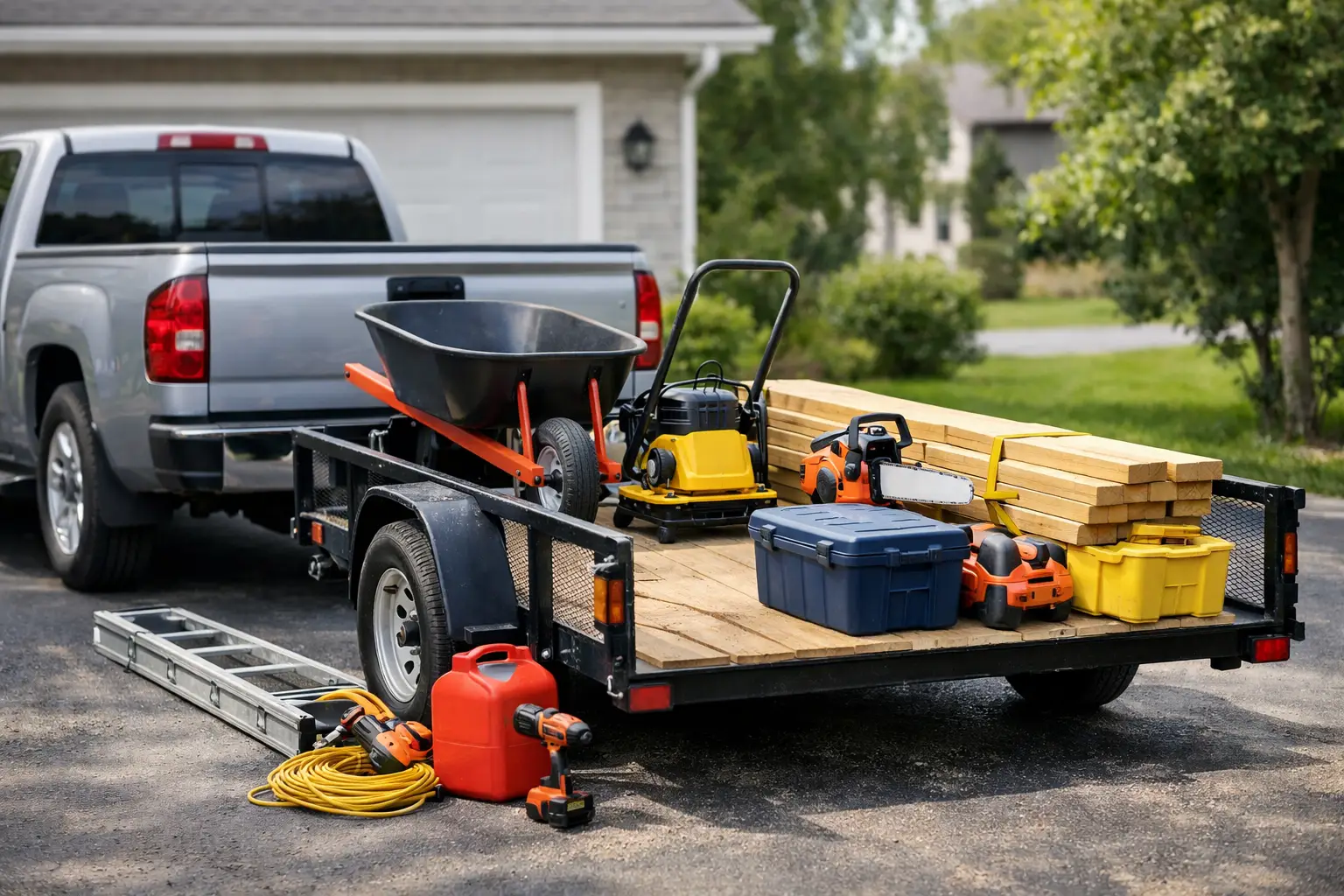
For furniture, tools, boxes, yard debris, or materials, an open utility trailer may be the better fit. Think about how the load will ride in the wind and whether it can be secured. Loose household items and lightweight debris can turn into road hazards quickly, especially on open stretches outside town.
For demolition debris, gravel, firewood, or landscaping material, focus on weight before volume. A trailer can look half empty and still be overloaded. Soil, rock, wet lumber, and green waste weigh more than many people expect. When in doubt, estimate conservatively and ask the rental provider what the trailer is rated to carry.
Match the Trailer to Your Tow Vehicle
A capable trailer does not help if the tow vehicle is not set up to pull it. Before booking, check your vehicle owner’s manual or the tow-rating information for your exact trim and configuration. Engine size, drivetrain, factory tow package, and passenger or cargo weight can all change the number.
Your vehicle’s tow rating needs to cover the loaded trailer, not just the empty trailer. Add the trailer’s empty weight to the weight of the vehicle, equipment, supplies, or material you plan to haul. Also pay attention to payload. Tongue weight presses down on the rear of the tow vehicle, and it counts against your vehicle’s payload capacity along with passengers and gear.
You will also need a properly rated hitch receiver, the right hitch ball size, functioning trailer wiring, and a working connector. Test your brake lights, turn signals, and running lights before leaving. If the trailer has brakes, make sure your vehicle is equipped to operate them as required.
A pickup may be the obvious choice for a heavy haul, but plenty of SUVs can tow smaller utility trailers safely when their ratings allow it. The right answer depends on the vehicle, the trailer, and the load. A quick phone call before booking can prevent a wasted trip or an unsafe setup.
Choose Enough Space Without Renting Too Much
Bigger is not always better. An oversized trailer may cost more, be harder to maneuver, and leave more room for a load to shift if it is not secured well. On the other hand, trying to save money with a trailer that is too short or too light can force you into multiple trips.
Measure long items such as lumber, appliances, ATVs, and vehicles. Consider ramp clearance if you are loading something low to the ground. For a car hauler, know whether the vehicle can be driven onto the trailer or whether it needs to be winched. For utility loads, consider whether tall sides or a tarp will help keep material contained.
It also helps to think through the entire day. Can you get the trailer into your driveway? Is there enough room to turn around at the pickup location, job site, or dump? Tight streets and steep drives around places like Jerome or Sedona can change what is practical. A smaller trailer that you can control confidently may be the smarter choice.
Load It Like You Plan to Arrive Safely
Loading is where a good rental experience can go wrong. The goal is a stable load with the proper tongue weight – generally enough weight forward of the trailer axle to keep the trailer tracking straight, but not so much that it overloads the rear of the tow vehicle.
Put heavier items low and centered, then distribute the weight evenly from side to side. Keep the load close to the trailer deck whenever possible. Tall, top-heavy loads are more likely to shift, especially through curves, crosswinds, and uneven roads.
Use rated straps, chains, or binders that fit the job. Rope may hold a box of light yard tools, but it is not the right answer for a vehicle, mower, or heavy equipment. Secure each major item independently and use multiple tie-down points when needed. After loading, walk around the trailer and check that ramps, gates, couplers, safety chains, and electrical connections are fully secured.
For a vehicle on a car hauler, use wheel straps or approved tie-down methods designed for vehicle transport. Set the parking brake only when appropriate for the setup, follow the equipment instructions, and avoid relying on the transmission or a single strap to keep the vehicle in place.
Give Yourself More Time on the Road
Towing changes how your vehicle accelerates, brakes, turns, and backs up. Leave more following distance than usual. Brake early and smoothly, take turns wider, and reduce speed before curves or downhill grades. The goal is not to keep up with traffic at all costs. The goal is to stay in control.
Arizona heat deserves attention, too. Check tire condition and pressure before the trip, including the trailer tires. Heat, speed, and heavy loads are hard on tires. Bring water, keep an eye on engine temperature, and avoid rushing a long haul during the hottest part of the day when possible.
If the trailer starts to sway, do not jerk the steering wheel or slam on the brakes. Ease off the accelerator, keep the wheel steady, and allow the combination to slow down. Once you are safely stopped, inspect the load distribution and tie-downs before continuing.
Backing up is easier when you slow down and make small steering corrections. If you are not comfortable backing a trailer, practice in an open lot before you reach a crowded driveway or job site. A spotter can help, but agree on clear hand signals before you begin.
Know What You Are Paying For
A fair rental price is about more than the daily number. Ask what is included, how long the rental period lasts, and what happens if you need extra time. Confirm the pickup and return process, especially if your schedule starts early or ends after normal business hours.
You should also understand the condition expectations. Return the trailer swept out, remove personal straps and debris, and report any issue that came up during the rental. Taking a few photos of the trailer at pickup and return is a simple habit that gives everyone a clear record.
Local service can make a real difference here. With Monsoon Trailer Rental, the point is straightforward: get dependable hauling equipment, easy booking, and contactless pickup and dropoff without dealing with a giant rental counter that treats a simple question like a problem.
A Quick Check Before You Pull Out
Before the trailer moves, take one final lap. Confirm the coupler is locked onto the ball, the safety chains are crossed and connected, the breakaway cable is attached if equipped, the jack is fully raised, and the lights work. Check tire pressure, tie-down tension, and that ramps or gates are latched.
Then stop again after the first few miles. Straps can settle, loads can shift, and a quick recheck is much easier than fixing a problem on the side of the road.
The right trailer rental should make your job easier, not add another project to the day. Choose equipment that fits the load, respect your tow vehicle’s limits, and give yourself time to secure and inspect everything. That is how a one-day haul stays a one-day haul.