

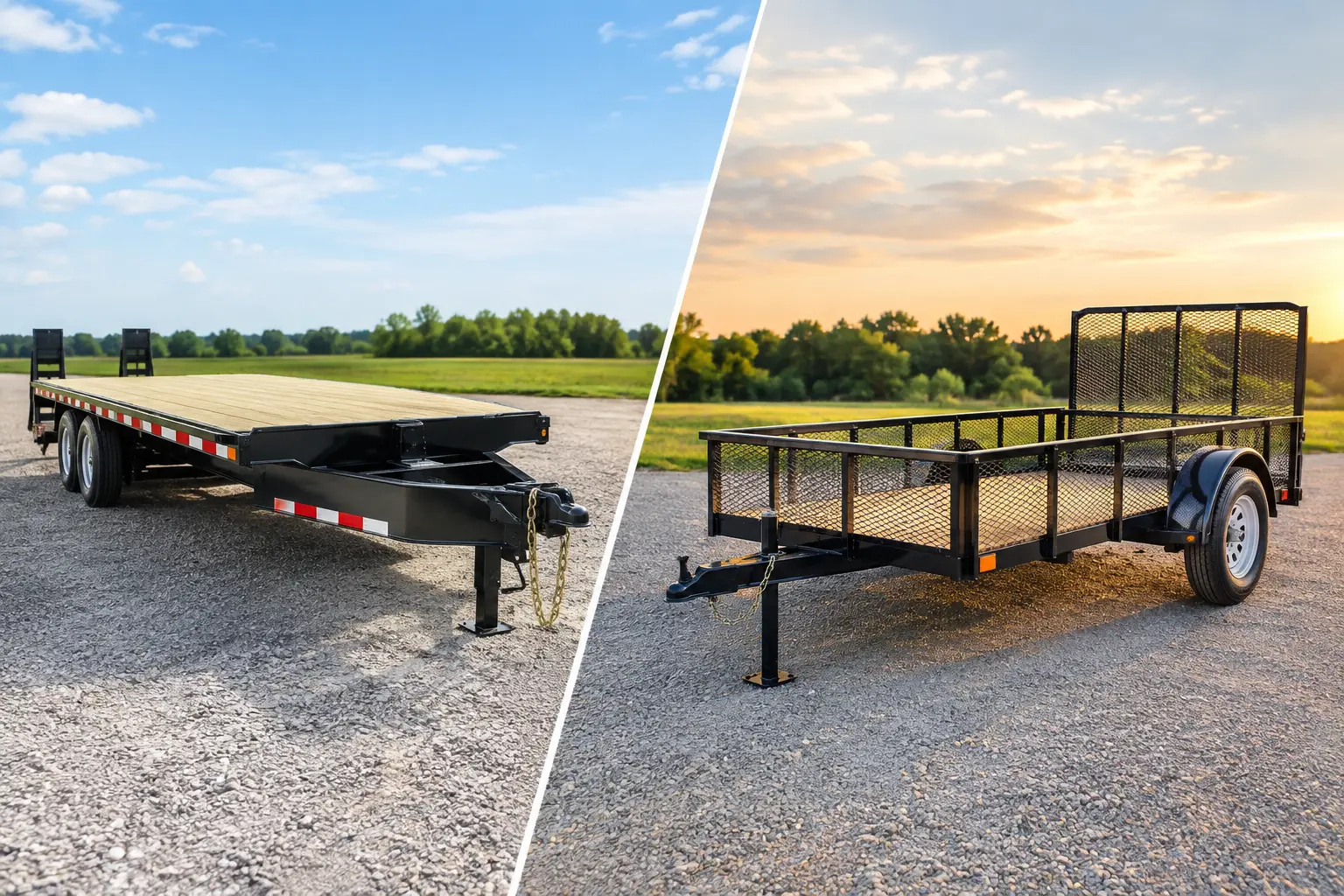
A trailer with tall sides can save a cleanup job. A wide, open deck can save a vehicle move. That is the real question behind flatbed versus utility: what are you hauling, how are you loading it, and what needs to stay contained on the way there?
For a quick run around Cottonwood, Camp Verde, or the rest of Verde Valley, choosing the wrong trailer can turn a simple job into extra loading, tie-down trouble, or a second trip. The best trailer is not always the biggest one. It is the one that matches the load, your tow vehicle, and the roads you will travel.
Flatbed Versus Utility Trailers at a Glance
A utility trailer is usually the better choice when your load benefits from sides, a rear gate, and easier containment. Think yard debris, bagged materials, tools, small equipment, furniture, or a weekend dump run. Its rails help keep loose or awkward items where they belong, especially when the road gets rough or the load shifts slightly.
A flatbed trailer has an open, level deck with more usable space around the cargo. It is built for loads that are long, wide, heavy, or difficult to fit between trailer sides. Vehicles, side-by-sides, tractors, pallets, construction materials, and larger equipment are common flatbed loads. Depending on the trailer setup, loading may be easier with ramps, and you have more room to position straps correctly.
Neither style is automatically better. A utility trailer offers more containment. A flatbed gives you more access and flexibility. The right answer depends on the job in front of you.
When a Utility Trailer Makes More Sense
Utility trailers earn their keep on everyday hauling jobs. If you are cleaning out a garage in Clarkdale, replacing landscaping in Cornville, or taking branches and brush to the disposal site, side rails make a noticeable difference. You can load steadily without worrying that every item needs to be strapped down individually just to stay inside the trailer.
They are also a practical fit for smaller equipment. A lawn mower, compact tiller, pressure washer, generator, or a few pieces of jobsite equipment can load easily through a rear gate. The gate may also act as a ramp, but confirm its rating before driving anything heavy onto it. Not every gate is intended for every machine.
A utility trailer works well when the cargo is irregular or loose, but it still needs to be secured. Sides are not a replacement for tie-downs. Furniture can lift in the wind, wheelbarrows can move, and a stack of lumber can slide under braking. Use rated straps, attach them to solid anchor points, and cover light debris with a tarp when needed.
The trade-off is capacity and access. Side rails can limit how you load wide materials. Long boards may hang over the front or rear, and bulky equipment may not fit between the rails. They also make it harder to load with a forklift from the side.
When to Rent a Flatbed Trailer
A flatbed is the right tool when the load needs room, not walls. If you are moving a vehicle, hauling a UTV, transporting a compact tractor, or carrying building materials that extend beyond a standard utility bed, the open deck is a major advantage.
The flat surface gives you more options for where to place the load. That matters because proper weight distribution affects how the trailer tows. In most cases, you want a portion of the loaded trailer weight carried by the hitch, with the load positioned slightly forward of the trailer axle or axles. Too much weight at the back can cause sway. Too much at the front can overload the rear of the tow vehicle and make steering less responsive.
Flatbeds also make strapping easier because you can reach the load from multiple sides. That is especially useful for vehicles and equipment. A car, for example, should be secured with appropriate wheel straps or rated tie-down points, not simply held in place by a strap over a bumper or suspension component.
The open design comes with more responsibility. A flatbed will not contain loose cargo for you. Boxes, tools, lawn equipment, and lightweight materials need careful placement and securement. If the load can roll, slide, bounce, or catch wind, it needs a plan before you leave the pickup location.
Choose by the Load, Not Just Trailer Size
It is easy to focus on deck length and forget the rest of the equation. Before booking, look at the actual cargo. Measure its length, width, height, and estimated weight. Include accessories, attachments, pallets, fuel, and anything else that will be on the trailer.
Then check the trailer’s payload capacity. Payload is what the trailer can safely carry, not its empty weight or the number printed on a generic online listing. Your tow vehicle also needs enough towing capacity for the loaded trailer. That includes the trailer itself, the cargo, passengers, tools, and anything loaded in the truck bed.
Hitch setup matters just as much. Make sure the ball size matches the trailer coupler, the hitch is properly rated, safety chains are crossed beneath the coupler, and the electrical connection works before pulling out. If the trailer has brakes, confirm the brake controller is compatible and adjusted correctly.
For first-time renters, this is where a local rental provider is worth calling. A quick conversation can prevent a mismatch between your vehicle, your cargo, and the trailer you reserve. Monsoon Trailer Rental can help renters choose equipment that makes sense for the actual haul, not just what looks like it might fit.
Consider How You Will Load and Unload
Loading is often the deciding factor in flatbed versus utility trailers. A load that can be carried safely is not always a load that can be loaded safely.
For wheeled equipment, ask whether you need ramps, a ramp gate, or another loading method. Check ramp width, weight rating, and angle. Low-clearance vehicles may need longer ramps to avoid scraping. Never try to improvise a ramp with loose boards, blocks, or materials not designed for the job.
For pallets or dense materials, consider whether a forklift will load from the rear or side. A flatbed usually offers better side access. For furniture, trash, landscaping waste, and smaller tools, a utility trailer may be easier to load by hand because the rails provide a natural boundary for stacking.
Also think about unloading at the destination. If you are dropping gravel tools at a steep Sedona driveway or backing into a tight Jerome worksite, a trailer that is easy to load at home may be harder to maneuver later. Plan the route in and out before the trailer is full.
Tow for the Roads You Actually Drive
Verde Valley hauling is not always a straight, flat highway run. Grades, curves, wind, rough access roads, and tight neighborhood turns all change how a loaded trailer behaves. Give yourself extra stopping distance, take turns wider, and avoid sudden steering corrections.
Before leaving, walk around the trailer. Confirm the coupler is latched and pinned, chains are connected, lights and brakes work, the jack is fully raised, and every strap is tight. Stop again after the first few miles to inspect the load. Straps can settle as cargo shifts into place.
Do not use a trailer to solve a load problem by overfilling it. A second trip is cheaper than damaged equipment, a citation, or an unsafe tow. If you are close to the trailer’s capacity, unsure about weight distribution, or trying to haul something unusually shaped, ask before you book.
The Practical Choice for Your Next Haul
Choose a utility trailer when you need rails, a gate, and simple containment for everyday materials and smaller equipment. Choose a flatbed when you need open deck space, side access, and room for vehicles, machinery, or oversized materials. Both can handle real work when they are loaded within their limits and matched to the tow vehicle.
Start with the cargo, measure it honestly, and give yourself some room to work. The right trailer should make the haul feel straightforward from pickup to drop-off, not like another problem waiting at the end of the driveway.

