

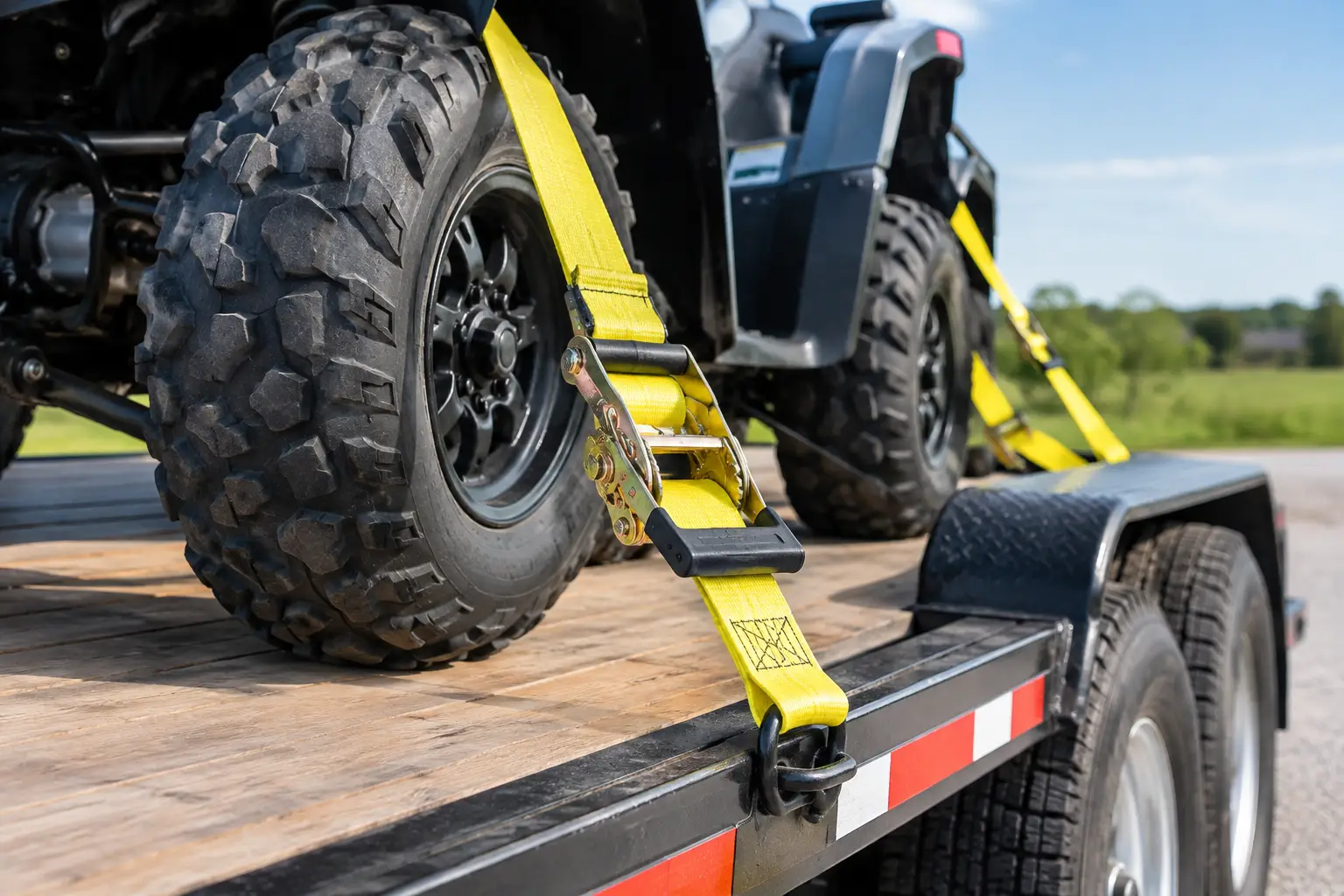
A trailer can have good tires, working lights, and plenty of deck space, then still become unsafe because the load was tied down with the wrong gear. The best tie downs for trailers are not always the biggest or most expensive option. They are the ones rated for the load, connected to solid anchor points, and used in a way that keeps cargo from shifting, bouncing, or coming loose.
For a short run across town or a vehicle move through the Verde Valley, taking a few extra minutes to secure the load is worth it. A loose mower, ATV, stack of lumber, or vehicle can turn an ordinary haul into damaged equipment, a road hazard, or a much longer day.
Start With the Load, Not the Strap
Tie-down selection starts with what is on the trailer. Soft cargo needs protection from abrasion. Heavy machinery needs hardware that can handle weight and movement. A car has different securement needs than a pallet of building materials.
The key number is the working load limit, often marked WLL. This is the maximum weight a tie-down is designed to hold in normal use. Do not use the higher break-strength number as your guide. Break strength is the point at which the gear may fail under testing, not the safe number for regular hauling.
Your complete securement setup is only as strong as its weakest part. That includes the strap or chain, hooks, ratchet, trailer anchor points, and any attachment point on the cargo. A strong strap clipped to a weak rail does not create a strong system.
For many loads, securement rules require the combined working load limit of the tie-downs to equal at least half the cargo weight. That is a useful minimum rule of thumb, but the number of tie-downs and their placement matter just as much. Long, heavy, or wheeled loads often need additional securement to control forward, rearward, and side-to-side movement.
Ratchet Straps Are the Best Tie Downs for Most Trailer Jobs
Ratchet straps are the everyday choice for many trailer loads. They are adjustable, reasonably easy to use, and available in a wide range of widths and working load limits. For homeowners, landscapers, and general jobsite hauling, they handle a lot of real-world work without making the process complicated.
A 1-inch ratchet strap can be useful for lighter cargo such as coolers, boxed materials, yard tools, or small furniture. It is not the right choice for securing a vehicle or heavy piece of equipment. For heavier cargo, 2-inch straps are a common step up because they generally offer higher working load limits and spread pressure over a wider area.
Ratchet straps work well when the strap can run over or around cargo without damaging it. Use edge protectors where a strap crosses a sharp metal edge, rough lumber, or a painted surface. A strap cut by an edge can fail quickly, even if it looked fine at the start of the trip.
Avoid twisting the webbing. A flat strap holds and wears more predictably. After tightening, lock the ratchet handle fully closed and secure loose strap tails so they cannot flap in the wind or get caught near wheels.
When Cam Buckle Straps Make Sense
Cam buckle straps are faster for light-duty loads and are less likely to be overtightened by hand. They are handy for bicycles, light equipment, bundled materials, and items that could be damaged by too much ratchet pressure.
Their trade-off is holding power. They are generally not the best choice for heavy loads or equipment that can shift under hard braking. If the load would be dangerous if it moved even a few inches, step up to rated ratchet straps or chains as appropriate.
Chains and Binders for Heavy Equipment
Grade-rated transport chains paired with properly rated binders are built for heavy equipment, steel items, tractors, skid steers, and other dense loads. They stand up well to sharp edges and heat that would damage a nylon strap. They also offer a secure connection when the machine has designated tie-down points.
Chains are not automatically better just because they are heavy. They can scratch paint, damage a frame if attached in the wrong place, and take more experience to tension correctly. A chain that is too loose can slap the trailer and work itself free. One that is severely overtightened can put unnecessary stress on the equipment and trailer.
For equipment hauling, use chain and binder combinations with a working load limit appropriate for the machine. Attach to manufacturer-approved tie-down points when available. Do not hook to hydraulic lines, steering components, suspension parts, or anything that was not meant to carry a securement load.
Wheel Nets and Axle Straps for Car Haulers
When hauling a car, truck, UTV, or other wheeled vehicle, the question is not simply whether the vehicle is strapped down. It is whether the securement method controls the vehicle safely without damaging it.
Wheel nets or tire baskets are often an excellent choice for vehicle transport. They hold the tire to the trailer deck instead of pulling directly on suspension or frame components. This lets the vehicle ride naturally on its own suspension during transport. They must fit the tire size, be connected to proper trailer anchors, and be positioned so the tire cannot roll out of the net.
Axle straps can also work well when used around a solid axle or an approved structural point. Pair them with ratchet straps or chain hardware that matches their rating. Never run a regular hook directly over a brake line, through a wheel opening without a proper method, or around a component that can bend or break.
On a car hauler, four-point tie-down is a dependable approach for most vehicles: one securement at each wheel area, arranged to resist movement in more than one direction. Check the trailer’s instructions and the vehicle manufacturer’s guidance if you are unsure. Some specialty vehicles need a specific method.
Hooks and Anchor Points Matter More Than They Seem
The strap is only one part of the job. Flat hooks, wire hooks, grab hooks, D-rings, stake pockets, and E-track fittings all need to match the trailer and the load.
A hook should sit fully in the anchor point, not balance on an edge or catch on a thin piece of metal. Do not use a hook with a bent tip, damaged safety latch, deep rust, or visible cracking. On the trailer, inspect D-rings, rub rails, stake pockets, and welded points before loading. If an anchor point is bent, loose, or heavily corroded, do not trust it with a heavy load.
It also helps to pull straps at opposing angles when possible. Straight-down tension may keep something from lifting, but it may not stop it from sliding forward during braking. Securement should control the directions the load could actually move.
A Quick Check Before You Pull Out
Before leaving the driveway, rental lot, or jobsite, walk around the trailer and check four things:
- Every strap, chain, hook, and anchor point is rated and undamaged.
- The load is balanced over the trailer and not leaning against one side.
- Tie-downs are tight, locked, and protected from sharp edges or hot surfaces.
- Loose ends, ramps, doors, tools, and accessories are secured separately.
Then stop after the first few miles and check again. Straps can settle into a load, tires can shift slightly, and a load that looked secure at rest may reveal movement on the road. Recheck at fuel stops and whenever road conditions get rough.
Common Tie-Down Mistakes That Cost People Time
The most common mistake is using too few tie-downs. One strap over the middle of a load may keep it from bouncing, but it does little to prevent forward or sideways movement. Another frequent problem is using old straps with sun-faded webbing, cuts, frayed stitching, or damaged ratchets. Retire questionable gear rather than hoping it lasts one more trip.
People also forget that a tarp, rope, or bungee cord is not a replacement for rated cargo securement. Those items may help contain light debris or cover materials, but they should not be the primary means of holding down equipment, lumber, or a vehicle.
Finally, do not overload the trailer or tow vehicle. The best tie-downs in the world cannot correct poor weight distribution, insufficient trailer capacity, or an overloaded hitch. Keep enough tongue weight for stable towing, stay within your equipment ratings, and make sure your cargo is secure before worrying about speed.
If you are renting a trailer and are not sure which tie-down setup fits the job, ask before you leave. At Monsoon Trailer Rental, a quick conversation about the load, trailer type, and destination can help you avoid bringing the wrong gear. A properly secured load makes the haul quieter, safer, and a whole lot less stressful.

