
A loose ATV can turn a simple weekend ride into an expensive roadside problem fast. Knowing how to haul ATVs safely comes down to using a trailer that fits the job, loading the machine with balance in mind, and securing it so it cannot shift when the road gets rough.
That matters around the Verde Valley, where a quick trip can include highway speeds, steep grades, uneven pavement, and plenty of wind. Do not count on a parking brake, a gear selector, or one strap hooked wherever it happens to fit. A safe haul starts before the wheels ever roll.
Start With the Right Trailer
The best trailer for an ATV is not necessarily the biggest one. It needs enough deck space for the ATV or side-by-side, enough payload capacity for the machine and any gear, and tie-down points that let you secure the load at proper angles.
Check the ATV’s actual weight in the owner’s manual or on the manufacturer label. Then add fuel, coolers, tools, ramps, and anything else riding along. The trailer’s payload rating must exceed that total. Do not confuse payload with the trailer’s total weight rating. The trailer itself has weight too, and your tow vehicle must be rated to pull the combined load.
An open utility trailer works well for many ATV hauls because it is easy to load, inspect, and strap down. A car hauler trailer can be a better fit for larger machines, multiple ATVs, or a heavier side-by-side. The right choice depends on the machine’s width, wheelbase, weight, and where you need it placed on the trailer.
Before booking, measure your ATV at its widest point and confirm the trailer deck width between the fenders. An ATV that technically fits but leaves no room to walk around or attach straps is not an easy or safe setup.
Match the Tow Vehicle to the Load
A properly loaded trailer cannot make up for an undersized tow vehicle. Check your vehicle’s towing capacity, hitch rating, and tongue-weight rating. Those numbers are set by the vehicle and hitch manufacturer, not by what the engine feels like it can pull.
You also need the correct hitch ball size and a locked coupler. After connecting the trailer, raise the jack fully, secure it, and attach the safety chains beneath the coupler in a crossed pattern. The crossed chains can help support the trailer tongue if the coupler ever separates from the ball.
Plug in the trailer wiring and test every light before leaving: running lights, brake lights, turn signals, and hazards. If the trailer has brakes, make sure the brake controller is set correctly and the breakaway cable is attached to the tow vehicle, not looped around the safety chains.
Load the ATV for Balance
The most common loading mistake is putting all the weight too far back. That can create trailer sway, especially at highway speed. Sway is not something to ignore or power through. It can quickly make both the trailer and tow vehicle hard to control.
As a general rule, about 10 to 15 percent of the loaded trailer weight should rest on the hitch as tongue weight. For a single ATV, that usually means placing the machine slightly forward of the trailer axle, not all the way at the front rail and not behind the axle.
Load on level ground when possible. Chock the trailer wheels before driving the ATV onto the ramps, and make sure the ramps are properly secured to the trailer. Use a low, steady throttle. Avoid sudden acceleration or sharp steering inputs that can put a tire off the ramp.
Once the ATV is in position, put it in park or in gear, set the parking brake, and turn off the fuel if the manufacturer recommends it for transport. These are backup measures, not substitutes for tie-downs.
How to Haul ATVs Safely With Proper Tie-Downs
Use purpose-built ratchet straps or heavy-duty cam buckle straps rated for the load. Frayed webbing, bent hooks, damaged ratchets, and cheap straps with no working load limit do not belong on a trailer. Bungee cords, rope, and light-duty utility straps are never a safe way to secure an ATV.
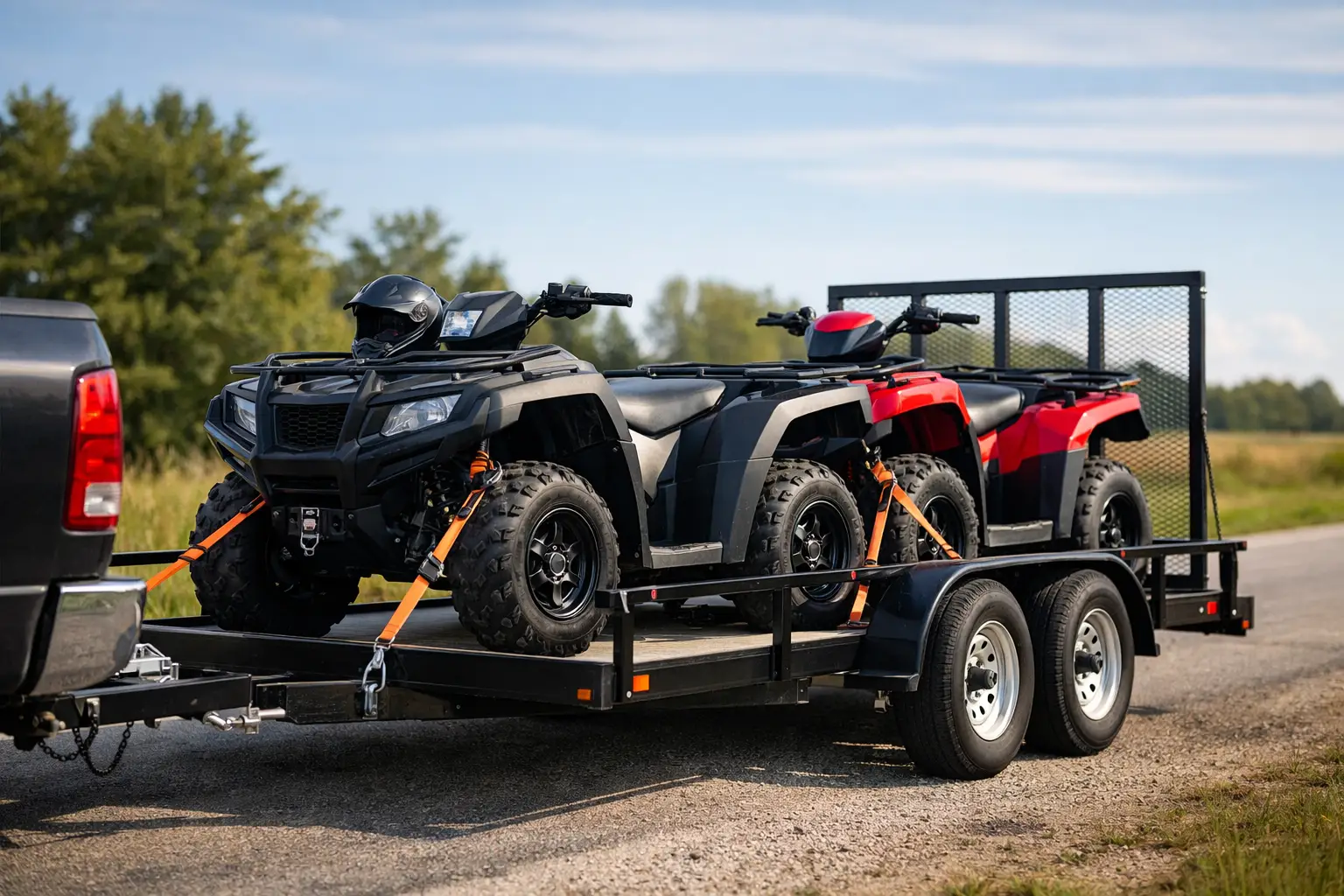
Most ATVs should be secured at four points: two at the front and two at the rear. Attach straps to strong, approved points on the ATV frame, suspension, or designated tie-down locations. Avoid plastic bodywork, handlebars, racks that are not rated for towing loads, brake lines, and sharp edges that can cut through a strap.
The front straps should pull forward and outward. The rear straps should pull back and outward. This cross-braced approach keeps the ATV from moving forward, backward, or side to side. Keep the strap angles wide enough to stabilize the machine without rubbing against tires, suspension parts, or body panels.
For many ATVs, lightly compressing the suspension helps keep the straps tight over bumps. Do not crank the suspension down until it is fully bottomed out. Too much compression can put unnecessary stress on the ATV and the straps. The goal is firm, even tension that holds the machine in place.
After tightening each strap, secure the loose strap tails so they cannot flap in the wind or get caught in a wheel. Add wheel chocks as another layer of security if they fit your trailer setup, but do not use chocks in place of four proper tie-downs.
Check the Load Before You Hit the Road
Walk around the trailer before you pull out. Look at the straps from every side. Make sure hooks are fully seated, ratchets are locked, ramps are stowed or pinned, and nothing can blow out of the trailer.
A good pre-trip check should cover these items:
- Trailer coupler locked onto the correct hitch ball
- Safety chains crossed and connected
- Trailer jack fully raised and secured
- Lights and brakes working correctly
- Tires properly inflated with no visible damage
- Four tie-downs tight and clear of moving parts
- Cargo, fuel cans, and gear secured separately
Stop again after the first 10 to 15 minutes of driving. Straps can settle once the ATV suspension moves and the trailer begins taking normal road vibration. Recheck tension, tire condition, and the coupler. For longer trips, inspect the load every time you stop for fuel or a break.
Drive Like You Have a Trailer Behind You
A loaded trailer changes how your vehicle accelerates, brakes, turns, and handles wind. Leave extra room behind other vehicles and begin braking earlier than usual. Make wider turns so trailer tires do not clip curbs, rocks, or parking-lot islands.
Keep your speed reasonable, even when the posted limit is higher. Trailer tires, crosswinds, downhill grades, and passing trucks all make higher speeds less forgiving. If the trailer starts to sway, do not slam on the brakes or jerk the steering wheel. Ease off the accelerator, hold the wheel straight, and let the rig slow down gradually. Then pull over safely and fix the cause before continuing.
When backing up, make small steering corrections. If you are new to towing, practice in an open lot before you get to a crowded trailhead or narrow driveway. A spotter helps, but agree on hand signals before starting and keep the spotter where you can see them.
Do Not Forget Arizona Heat and Terrain
Arizona heat is hard on tires, bearings, and tow vehicles. Check trailer tire pressure when tires are cold, and do not exceed the tire’s load rating or speed rating. A tire that looks fine can still be old, cracked, or underinflated.
If you are hauling through hill country or heading toward a remote riding area, plan fuel stops and avoid overloading the tow vehicle with unnecessary gear. Downshift on long descents when appropriate instead of riding the brakes all the way down. A little planning keeps a fun riding day from becoming a recovery job.
If you need a dependable trailer for an ATV, a pair of machines, or a heavier side-by-side, Monsoon Trailer Rental can help you choose a setup that makes sense for the load. Book the trailer that fits, strap the ATV down right, and give yourself enough time for a real pre-trip check. That is how a good ride starts before you even reach the trail.