
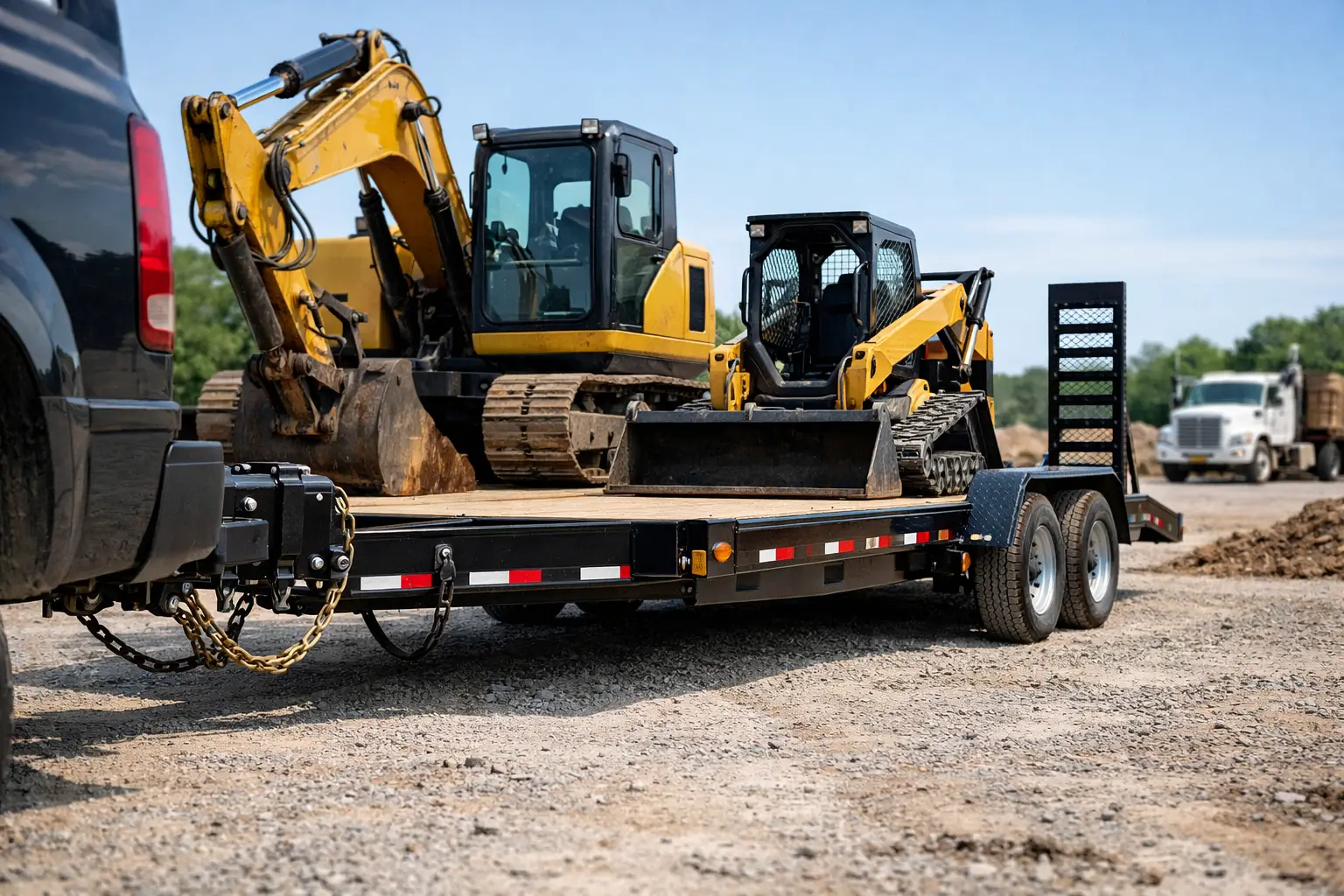
You usually find out what matters in an equipment trailer review when you’re already under a deadline. The skid steer needs to move by noon, the compact tractor has to get across town, or a jobsite change just turned into a hauling problem. At that point, nobody cares about fancy marketing. You care about whether the trailer loads easily, tows straight, stops safely, and fits the machine you actually need to move.
Equipment trailer review: what actually matters
For most renters and small crews, an equipment trailer is not about looks. It is about working without drama. A good trailer should feel predictable behind the truck, give you enough deck space to position the load properly, and have ramps that do not turn loading into a wrestling match.
That is why a real equipment trailer review should focus on a few basics first. Payload matters more than empty trailer weight on a spec sheet. Deck length matters more than just saying a trailer is “heavy duty.” Brake performance matters because a loaded trailer that pushes the tow vehicle around is not just inconvenient – it is unsafe.
The right review also has to be honest about trade-offs. A bigger trailer gives you more flexibility, but it can be harder to maneuver into a tight driveway or jobsite. A heavier-duty build can tow more, but it also asks more from your truck. There is no perfect trailer for every load. There is only the right trailer for the job in front of you.
Start with the load, not the trailer
A lot of people shop backwards. They start by asking what trailer is available, then try to make their equipment fit. It should be the other way around. Before you rent, know the operating weight of what you are hauling, the attachment weight if you are bringing buckets or implements, and the overall width and wheelbase.
A mini excavator, stand-on skid steer, compact tractor, or scissor lift can all fall into very different weight ranges even if they look similar at a glance. That difference affects axle choice, braking, deck space, and how much margin you have left for chains, fuel, and accessories.
If you are close to the trailer’s capacity on paper, that is a sign to slow down and verify everything. Safe hauling leaves room for real-world conditions. Wet dirt packed in tracks, added attachments, and loading angle all change the picture.
Deck size and usable space
Deck length is not just about whether the machine fits. It affects balance. If the equipment barely fits between the ramps and the front rail, you lose flexibility to shift weight for proper tongue load. That can lead to sway, poor braking feel, or a trailer that simply does not tow right.
Width matters too, especially for equipment with attachments or wider stance tires. A trailer that looks fine from the side can become a headache once you start lining up the machine to load. In practice, a little extra deck room often makes loading faster and less stressful, especially for first-time renters.
GVWR and payload are not the same thing
This is where people get tripped up. GVWR is the maximum total weight of the trailer and its cargo together. Payload is what you can actually put on the trailer after subtracting the trailer’s own weight. For a practical equipment trailer review, payload is the number that deserves your attention.
A trailer can sound impressive because it has tandem axles and a stout frame, but if the empty trailer is heavy, your usable payload may be lower than expected. That does not make it a bad trailer. It just means you need to match it honestly to the job.
Towing behavior tells you a lot
The best trailers tend to disappear behind the truck in the right way. Not literally, of course, but in the sense that they track straight, brake evenly, and do not keep reminding you they are back there. That is one of the clearest signs of a well-matched setup.
A solid equipment trailer should feel stable at normal road speeds, including on rougher county roads and uneven pavement. It should not bounce excessively when empty, and it should settle predictably once loaded. Some stiffness is normal on a heavy-duty trailer with no load, but harsh hopping or twitchy behavior is a warning sign to check tire pressure, suspension condition, and load placement.
Brakes deserve special attention. Electric brakes that engage smoothly make a huge difference, especially when coming down grade or dealing with stop-and-go traffic. If braking feels grabby, delayed, or uneven, that is not something to ignore.
Ramps can make or break the job
A lot of trailer reviews spend too much time on axle ratings and not enough on ramps. That is a mistake. If you are hauling equipment, the loading process is half the battle.
Good ramps should feel secure, line up cleanly, and give you a workable angle for the machine. Too steep, and low-clearance equipment can drag or hang up. Too flimsy, and the loading experience feels sketchy even when the trailer is technically within spec.
Spring-assisted ramps or ramps that are easy to lift matter more than people think. At the end of a long day, simple things like not fighting heavy steel by hand make the whole rental experience better.
Build quality matters, but so does maintenance
Frame strength, weld quality, coupler condition, tire health, lighting, jack operation, and deck condition all matter. But here is the real-world truth: even a well-built trailer can be a bad rental if it is not maintained.
That is why a practical review should look beyond brochure features. Are the tires in good shape with even wear? Does the wiring work without flickering lights? Do the ramps latch properly? Does the coupler close securely and the jack crank smoothly? Those are the details that affect your day.
This is where renting from a local company can be a real advantage. You are more likely to deal with a team that knows the equipment, checks it between rentals, and actually answers questions if something comes up. In a place like the Verde Valley, where jobs range from home projects to contractor runs and vehicle moves, that kind of straightforward service goes a long way.
Who should rent an equipment trailer?
An equipment trailer makes sense when you need serious hauling capacity without owning another piece of equipment year-round. That fits a lot of people. Homeowners moving rented machinery for a weekend project, landscapers hauling compact equipment, contractors shifting tools between jobs, and vehicle owners moving a machine or project car all run into this need.
Owning can make sense if you haul every week and already have the truck, storage space, and maintenance routine for it. But for many people, renting is the cleaner answer. You get the trailer when you need it, skip long-term upkeep, and avoid tying up money in something that spends most of its life parked.
What first-time renters often overlook
The trailer is only part of the setup. Your tow vehicle’s capacity, hitch rating, brake controller, ball size, wiring connector, and mirrors all matter. So does basic securement. A trailer may be fully capable of handling the load, but the entire combination still has to work together.
First-time renters also tend to underestimate loading time. Give yourself margin. Loading carefully beats rushing and correcting mistakes after the machine is already halfway up the ramps.
If you are unsure, ask questions before pickup. A good rental company should help you match the trailer to the job instead of leaving you to guess. That kind of help is worth more than shaved-down pricing that leaves you stuck with the wrong setup.
A fair equipment trailer review comes down to fit
So, what is the verdict in a straight equipment trailer review? A good equipment trailer earns high marks when it carries the right load safely, loads without hassle, brakes with confidence, and feels stable on the road. It does not need to be flashy. It needs to be dependable.
For real hauling jobs, the best trailer is usually not the biggest one on the lot or the cheapest one available. It is the one that matches your machine, your truck, and the roads you are actually driving. If you can get that plus fair pricing, contactless pickup and dropoff, and a team that actually picks up the phone, you are in good shape.
Before you book, take five extra minutes to verify your load weight, dimensions, and tow setup. That small step usually makes the difference between a smooth haul and a long day.