
If you need to move a vehicle and you’re weighing a car hauler vs tow dolly, the wrong choice usually shows up halfway through the job – when loading gets sketchy, towing feels unstable, or you realize your vehicle should not have been pulled that way in the first place. This is one of those rentals where a little planning saves a lot of trouble.
For most people, the decision comes down to three things: what vehicle you’re moving, what tow vehicle you’re using, and how much simplicity you want once you’re on the road. Both options can get the job done. They just do it in very different ways.
Car hauler vs tow dolly: the basic difference
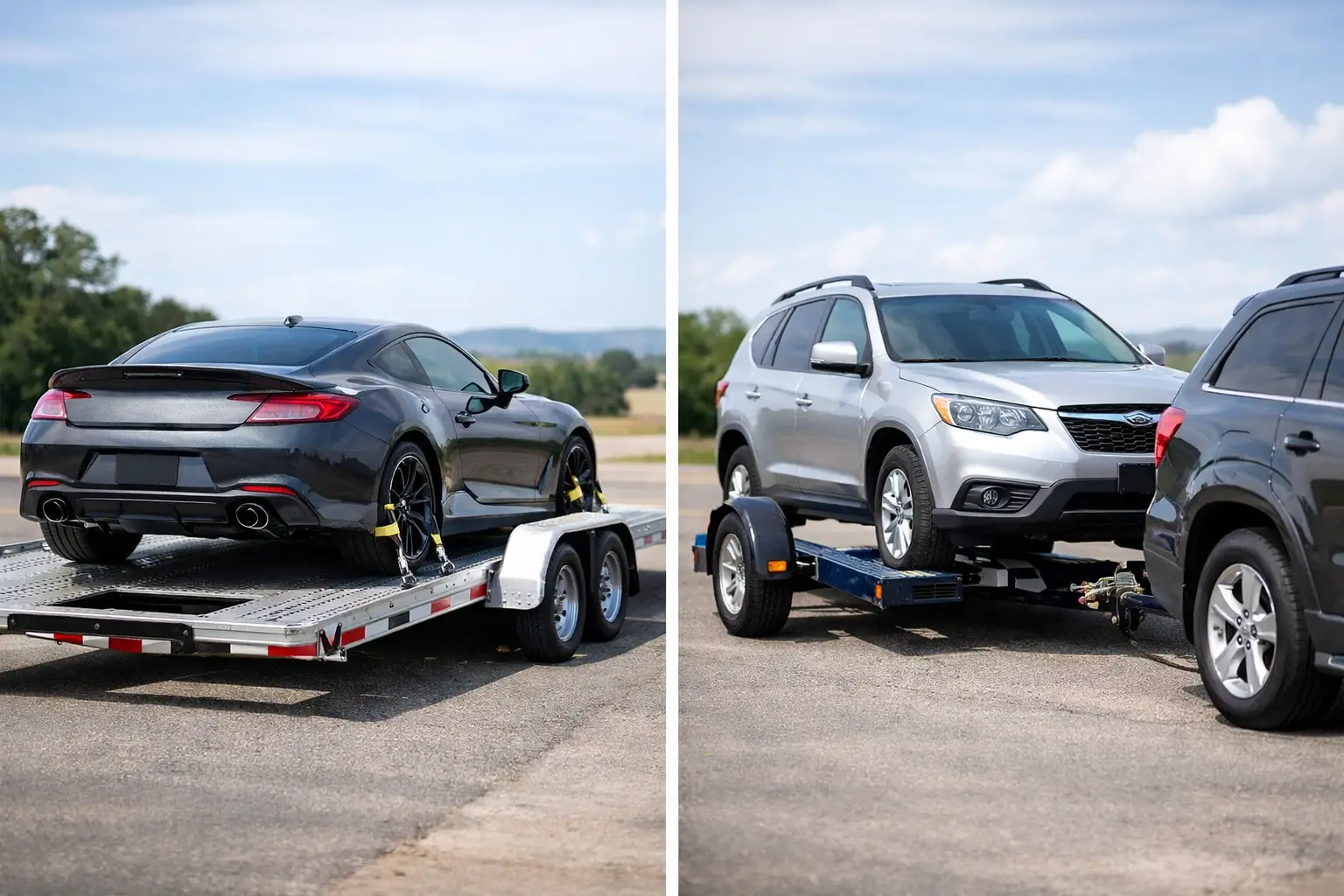
A tow dolly lifts the front wheels of the vehicle off the ground while the rear wheels stay on the road. It’s smaller, lighter, and often cheaper to rent. That makes it appealing for short moves and for people towing with a vehicle that has limited capacity.
A car hauler is a full trailer that carries the entire vehicle with all four wheels off the ground. It takes up more space and usually costs more than a dolly, but it gives you a more controlled setup and works with a wider range of vehicles.
That simple difference affects almost everything else – loading, braking, tire wear, drivetrain safety, backing up, and how stressful the tow feels.
When a tow dolly makes sense
A tow dolly can be a practical choice when the vehicle is front-wheel drive, the trip is fairly straightforward, and you’re trying to keep weight and cost down. If you’re moving a compact sedan or small crossover a moderate distance, a dolly may be all you need.
Its lighter weight matters. If your tow vehicle is near its towing limit, a dolly may keep the total load more manageable than a full car hauler. It can also be easier to store when not in use, and some renters like that it feels less bulky during pickup and drop-off.
But this is where people can get themselves into trouble. A tow dolly is not a universal answer. Rear-wheel drive, all-wheel drive, and four-wheel drive vehicles often require more caution, and some should not be towed on a dolly at all unless very specific manufacturer instructions are followed. Transmission and drivetrain damage can get expensive fast.
A dolly also leaves two tires on the road. That means those tires still wear during the trip, and the vehicle’s rear wheel bearings, suspension, and other components are still part of the equation. For some cars, that’s fine. For others, it is not the best move.
When a car hauler is the better call
A car hauler is usually the safer, more flexible option when you want fewer question marks. Since the whole vehicle rides on the trailer, you avoid a lot of the fit and drivetrain concerns that come with a tow dolly.
That matters if you’re moving an all-wheel drive vehicle, a rear-wheel drive vehicle, a disabled car, or something that just does not lend itself to partial towing. It also helps when the vehicle has low ground clearance, unknown mechanical issues, or tires you don’t want rolling down the highway for a hundred miles.
A full trailer generally feels more planted, too, especially when it’s properly loaded with the correct tongue weight and tied down the right way. You have brakes, balance, and a setup that’s built for carrying the whole vehicle rather than dragging part of it behind you.
For many renters, the biggest advantage is peace of mind. A car hauler is not always the cheapest option up front, but it can be the cheapest option once you factor in reduced risk, easier loading for many vehicles, and fewer compatibility problems.
The biggest trade-offs in car hauler vs tow dolly rentals
The real choice is not just price. It’s price versus margin for error.
A tow dolly is usually cheaper and lighter. That’s the upside. The downside is that vehicle compatibility matters more, loading angles can still be tricky, and backing up is generally limited or not recommended in many situations. If you miss something on setup, the trip gets stressful in a hurry.
A car hauler asks more from your tow vehicle because the trailer itself weighs more. You also need enough space to maneuver it and park it. But once the vehicle is fully loaded, the towing experience is often more straightforward.
So if your top priority is keeping rental cost and trailer weight down, a tow dolly may win. If your top priority is stability, broader vehicle fit, and fewer what-if moments, a car hauler usually comes out ahead.
Vehicle type matters more than most people think
This is where a lot of first-time renters guess instead of checking.
Front-wheel drive vehicles are often the easiest candidates for a tow dolly, assuming the weight and tire size fit the dolly’s limits. Rear-wheel drive vehicles can be more complicated because the rear wheels remain on the road. All-wheel drive and four-wheel drive vehicles often call for a full trailer unless the manufacturer clearly allows a different method.
Ground clearance matters too. Low cars, long front overhangs, and aftermarket body kits can make loading a challenge. A car hauler with proper ramps and a full support deck is often the better fit for sports cars, lowered vehicles, or anything with a front end you do not want scraping.
Then there’s the condition of the vehicle. If it does not run well, does not brake properly, has damaged steering, or has questionable tires, a full car hauler is usually the smarter answer. A tow dolly assumes more from the vehicle being towed.
Your tow vehicle has to match the job
Even the right trailer becomes the wrong trailer if your truck or SUV is undersized.
Before renting anything, check your tow rating, hitch rating, tongue weight capacity, brake setup, and connector type. A lot of people look only at the advertised tow number and forget that payload, passengers, cargo, and trailer weight all count. Add the weight of the vehicle you’re hauling, and the margin can disappear quickly.
If your tow vehicle is borderline, that may push you toward a tow dolly. But borderline towing is its own warning sign. Sometimes the better answer is not the lighter trailer. It’s a more capable tow vehicle or a different hauling plan.
A good rental conversation should cover this before keys change hands. That’s one reason working with a local company that actually answers the phone helps. If you’re in the Verde Valley and trying to sort out the fit, Monsoon Trailer Rental can usually save you from renting the wrong setup just because it looked cheaper at first glance.
What towing feels like on the road
Most people asking about car hauler vs tow dolly are really asking a simpler question: which one is less stressful to tow?
Usually, that’s the car hauler.
A full trailer can feel more predictable because the load is fully supported and better balanced when loaded correctly. Braking and tracking tend to feel more controlled. Crosswinds, bumps, and uneven pavement still matter, but the setup is generally more forgiving.
A tow dolly can tow just fine when everything is matched correctly. But it gives you less room for bad assumptions. Tire condition on the towed vehicle matters. Steering alignment matters. Drivetrain compatibility matters. And because part of the vehicle stays on the ground, you can feel more of what that vehicle is doing behind you.
That does not mean dollies are bad. It means they reward careful matching and proper use.
Which option is better for most renters?
For a straightforward front-wheel drive vehicle and a tow vehicle with modest capacity, a tow dolly can be a smart, budget-friendly solution.
For almost everything else, a car hauler is often the better rental.
If you’re moving a valuable vehicle, towing a longer distance, dealing with an all-wheel drive system, hauling a non-running car, or simply wanting the easiest path with the fewest unknowns, the full trailer usually justifies the added cost.
That is especially true for people who do not tow often. Experienced haulers may be comfortable working inside the tighter limits of a tow dolly. First-time renters usually appreciate the extra margin a car hauler provides.
How to make the right call before you book
Start with the vehicle owner’s manual and the towing specs for your tow vehicle. Those two sources answer a lot more than guesswork ever will. Then think honestly about your route, distance, comfort level, and the condition of the vehicle being moved.
If the vehicle has any drivetrain question marks, sits low, does not run properly, or you simply want the least complicated option, lean toward the car hauler. If the vehicle is a good match for a dolly and your tow setup is on the lighter side, the tow dolly may be the practical choice.
The best rental is not the cheapest one on paper. It’s the one that lets you finish the haul without white-knuckle driving, scraped bumpers, or damage you could have avoided.
When you’re not sure, ask before you hook up. A five-minute conversation can save a whole day of problems.