
A dead battery, a project car that will not make the drive, a vehicle sold across town, or a breakdown that needs more than a tow strap – those are the jobs that call for a car hauler rental in Clarkdale. The right trailer lets you move a vehicle on your schedule without paying for a long-distance tow or trying to make an unreliable vehicle go one more mile.
The job is straightforward when the equipment matches the vehicle and your tow rig is ready. A car hauler is not just a bigger utility trailer. Vehicle weight, trailer capacity, loading angle, tie-down points, and towing setup all matter before you pull out of the driveway.
Car Hauler Rental Clarkdale: Start With the Vehicle
Before booking, know what you are hauling. Have the year, make, model, approximate weight, and overall width of the vehicle ready. If the vehicle has oversized tires, a low front bumper, poor ground clearance, or is not running, mention that up front. Those details can affect whether it will load cleanly and whether a standard car hauler is the right fit.
A compact sedan and a full-size pickup are very different loads. So are a stock vehicle and a lifted Jeep with wide tires. Do not guess based only on how big the vehicle looks. Check the vehicle’s curb weight and compare it with the trailer’s rated capacity. The trailer needs to handle the vehicle, and your tow vehicle needs to handle the combined trailer and vehicle weight.
If you are hauling a non-running vehicle, think through how it will get onto the trailer. A vehicle that rolls and steers is easier to manage than one with locked wheels or damaged suspension. Let the rental team know what you are dealing with so you can plan for a safe load instead of figuring it out at the pickup location.
Make Sure Your Tow Vehicle Is Ready
The trailer may be available, but that does not automatically mean your truck or SUV is set up to tow it. Your owner’s manual and door-jamb labels are the place to start. Check your tow rating, payload capacity, hitch rating, and receiver size. The lowest-rated part of the setup sets the limit.
You also need the correct hitch ball size and a properly rated ball mount. The trailer should sit level or close to level when connected. A nose-high or nose-low trailer can affect handling, braking, and load balance. Make sure your safety chains can cross beneath the coupler without dragging and that your electrical connector works before loading the vehicle.
Trailer brakes are another item to confirm. Depending on the trailer and load, your tow vehicle may need a functioning brake controller. Do not leave that question for the morning of the move. A quick check before booking can save you from an avoidable delay.
For a first-time renter, this is where local service makes a difference. You should be able to ask direct questions and get clear answers about the trailer, the hookup, and what you need to bring. Monsoon Trailer Rental keeps the process practical, with dependable equipment and a team that actually picks up the phone.
Load the Car With Balance in Mind
A car hauler should be loaded with the vehicle facing forward unless you have been specifically advised otherwise. The goal is proper tongue weight, which helps the trailer track behind the tow vehicle instead of swaying. In most cases, that means positioning the heavier portion of the load slightly ahead of the trailer axles.
Do not assume the vehicle needs to be driven all the way to the front rail. Load it, stop, and look at the trailer’s stance. Too little weight on the hitch can lead to sway. Too much can overload the rear of the tow vehicle, reduce steering control, and make the front end feel light. If the setup does not look right, reposition the vehicle before securing it.
Low-clearance cars need extra attention on ramps. A steep approach can scrape bumpers, exhaust components, or air dams. Take your time, use a spotter when possible, and never stand in the path of a moving vehicle. If you are using a winch, keep people clear of the cable and the vehicle while it is under tension.
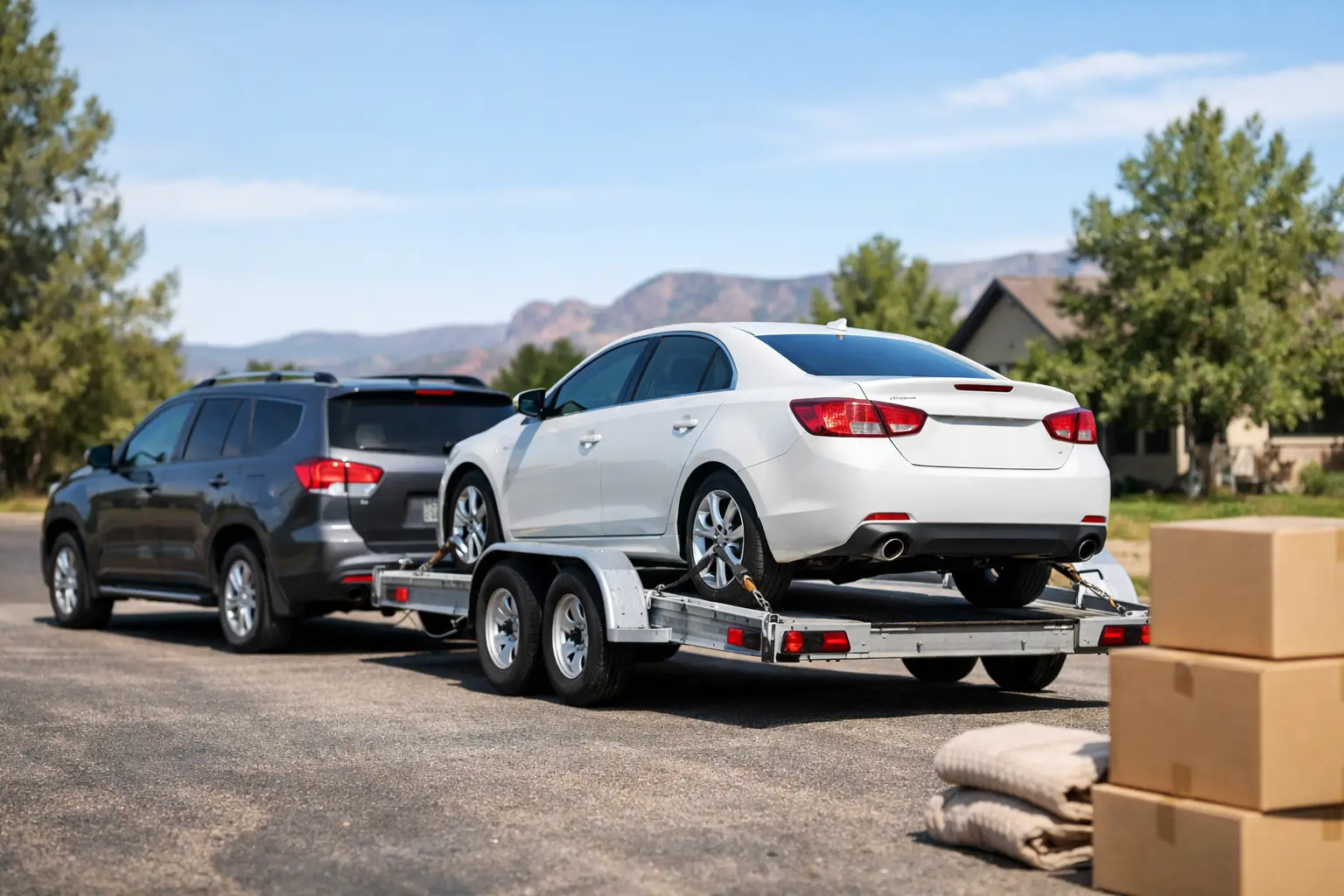
Once the car is in place, put it in park if it has an automatic transmission, set the parking brake, and secure it with appropriate wheel straps or axle straps. Tie-downs should be rated for the load and attached to solid, approved points. Four-point securement is the standard approach for most vehicle hauling jobs. Avoid relying on the parking brake, transmission, or a single chain to hold the vehicle in place.
After securing the vehicle, check that straps are not rubbing sharp edges, brake lines, suspension parts, or body panels. Then drive a short distance and stop to inspect every strap, chain, coupler connection, and light. Straps can settle once the vehicle shifts into its final position. Checking early is a lot easier than fixing a loose strap on Highway 89A.
Plan the Route for the Load You Have
The shortest route is not always the best towing route. Around Clarkdale and the Verde Valley, grades, tight turns, traffic, and changing weather can make a loaded trailer feel very different from an empty one. Give yourself more stopping room, take turns wider, and allow extra time for every part of the trip.
Stay in the right lane when practical, keep your speed reasonable, and avoid sudden steering inputs. If the trailer begins to sway, do not hit the brakes hard or try to steer out of it. Ease off the accelerator, hold the wheel steady, and let the combination slow down in a controlled way. Proper loading is the best prevention, which is why it is worth getting right before departure.
Pay attention at fuel stations, parking lots, and driveways. The trailer tracks inside the path of the tow vehicle during a turn, so a corner that is easy in a pickup can put trailer tires over a curb or into landscaping. Backing is easier with a spotter, especially in tight residential areas. Agree on hand signals before you start, and stop immediately if you lose sight of the person guiding you.
Book for the Whole Job, Not Just the Drive
A car move usually takes longer than the map estimate. You may need time to inspect the trailer, connect it, load the vehicle, make a safety check, fuel the tow vehicle, unload at the destination, and return the trailer. Build that time into the rental period so you are not rushing the safest parts of the job.
When you book, share the vehicle details, your intended pickup and return timing, and any concerns about loading. If you need flexibility around a work schedule or vehicle handoff, ask about contactless pickup and drop-off options. Easy booking is useful, but clear communication is what keeps the day moving.
A car hauler rental is a practical tool for a practical job. Get the right trailer, verify your tow setup, load carefully, and give yourself room to drive without rushing. Then you can spend less time fighting the move and more time getting the vehicle where it needs to go.