
A load can feel solid in the driveway and still shift badly once you hit a rough stretch of road. That is why knowing how to secure hauling equipment matters before you leave, not after you notice the trailer pulling strange or hear something banging around behind you. Whether you are moving a mower, compact tractor, side-by-side, building materials, or a vehicle, the goal is the same – keep the load stable, protect the equipment, and get the job done without creating a hazard.
What secure hauling really means
A lot of people think securing a load just means throwing on a couple of straps and tightening them until they look good. In practice, it is more than that. A secure load stays in place when you accelerate, brake, turn, hit bumps, or deal with crosswinds. If the equipment can roll, bounce, pivot, or slide, it is not fully secured.
This is where people get into trouble with heavy equipment and trailers. The trailer may be rated for the weight, but that does not guarantee the cargo is tied down correctly. The right trailer, the right tie-down points, and the right securing method all have to work together.
Start with the right trailer for the job
If you want to know how to secure hauling equipment the right way, start before the equipment ever touches the deck. The trailer needs to match the size, weight, and shape of what you are hauling. Too small, and you may not have proper tie-down spacing or enough deck room for good balance. Too large can also create problems if the load is too light for the setup or hard to position over the axles.
For wheeled equipment, a car hauler or equipment trailer usually makes more sense than trying to make a general utility trailer do a job it was not built for. A trailer with solid tie-down points, a stable deck, working ramps, and the right weight rating gives you a much better starting point. This is one reason local renters often do better with a company that actually talks through the haul instead of handing over keys and sending them on their way.
Know your equipment weight and trailer limits
Before loading, confirm the weight of the equipment and compare it to the trailer’s payload capacity. Then factor in attachments, fuel, tools, or anything else riding with it. People commonly remember the machine and forget the bucket, pallet forks, spare tire, or packed toolbox.
Weight also has to be positioned correctly. Too much forward can overload the tongue or rear of the tow vehicle. Too much to the back can cause sway, and sway is one of the fastest ways to turn a manageable haul into a dangerous one. A well-secured load is not just tied down – it is balanced.
A good rule is to place the equipment so the trailer carries the weight evenly with proper tongue weight on the hitch. Exact numbers depend on the trailer and tow vehicle, but if the trailer squats badly at the hitch or feels light and loose behind the vehicle, stop and adjust before driving farther.
Load on level ground when you can
Loading on a slope makes everything harder. Equipment can roll unexpectedly, ramps can shift, and your tie-downs may end up uneven because the trailer is twisted or angled. Flat, level ground gives you a cleaner setup and a safer loading process.
Before loading, check that the coupler is latched, safety chains are connected, the jack is up, and the trailer is stable. If the trailer has brakes, lights, or ramps, inspect those too. It only takes a minute, and it can save you a long afternoon on the side of the road.
Use the right tie-downs, not whatever is lying around
One of the most common mistakes is using worn-out straps, mismatched chains, or hardware-store rope for heavy hauling. Rope has its place, but not for securing serious equipment to a trailer. If the load has real weight behind it, use tie-downs rated for that job.
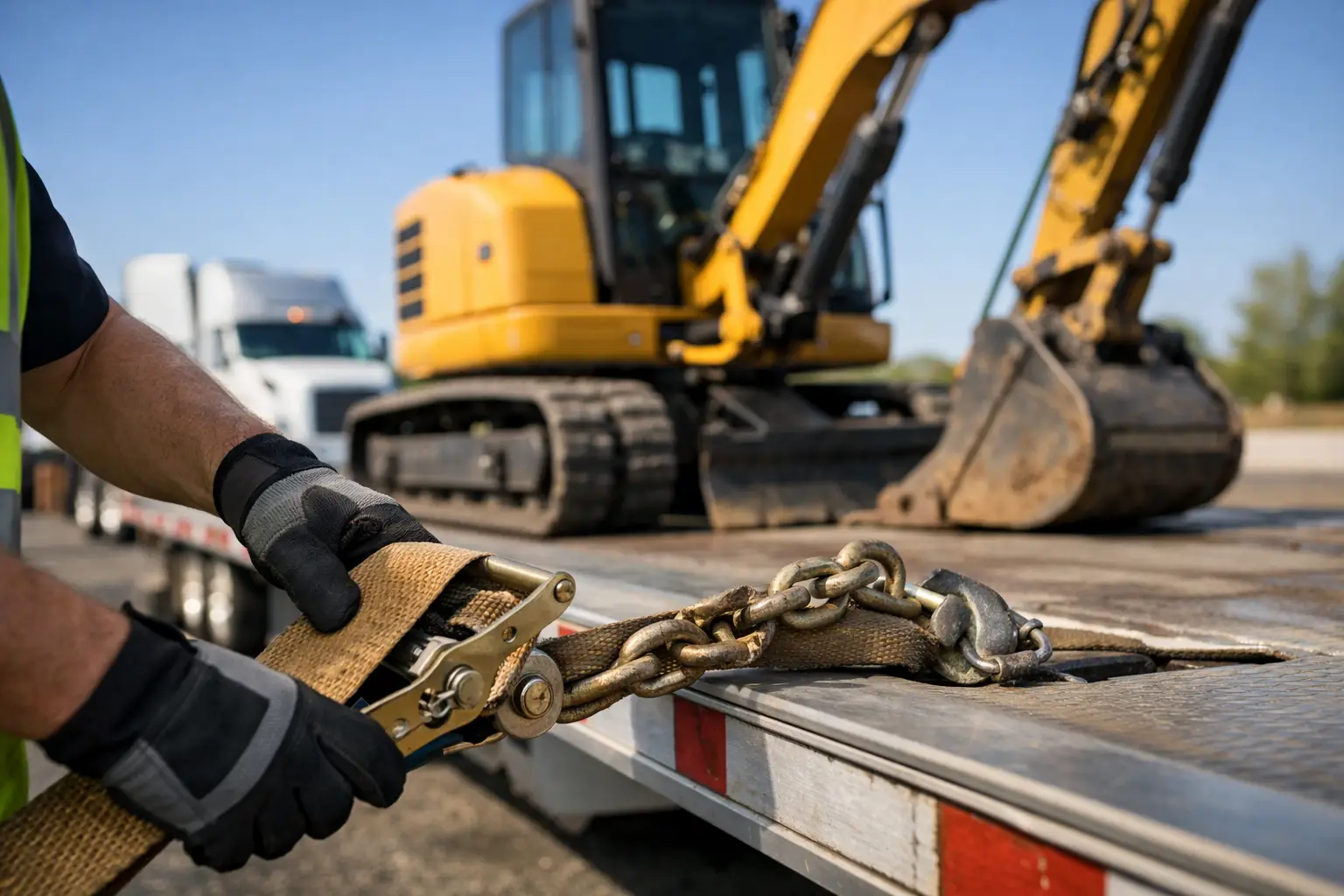
Ratchet straps work well for many loads, especially lighter equipment and materials, as long as the straps are in good condition and have the right working load limit. Chains are often the better choice for heavier machines because they resist abrasion and hold up well under high tension. Either way, damaged gear should not be part of the plan. Frayed webbing, bent hooks, stretched links, and rusted binders are all signs to replace the tie-down, not trust it.
Tie-down ratings matter. The combined working load limit of your securement gear needs to match the load you are controlling. If you are not sure what is required, ask before you haul. Guessing with heavy equipment is a bad bargain.
Secure the equipment at solid anchor points
The best tie-down in the world will not help if it is hooked to a weak or moving part. Attach straps or chains to manufacturer-approved tie-down points on the equipment whenever possible. Axles, designated frame points, and built-in D-rings are usually better choices than flimsy guards, rails, or removable attachments.
On the trailer side, use fixed anchor points designed for hauling. Stake pockets, D-rings, or heavy welded attachment points are there for a reason. Avoid wrapping tie-downs around parts of the trailer that were never meant to carry securement force.
The basic idea is to control movement in every direction. The load should be restrained forward, backward, side to side, and upward. That is why four-point securement is so common for wheeled equipment. Two tie-downs may keep something from rolling off in a perfect world, but real roads are not perfect.
Watch your angles and tension
Tie-down angle matters more than many first-time renters expect. A nearly vertical strap may help with bounce but do less to stop side movement. A strap pulled too flat may not do enough to control upward motion. You want angles that help hold the load down and keep it from shifting.
Tension should be firm and even. Overtightening can damage some equipment or put unnecessary stress on tie-down points. Too loose, and the load can move enough to slacken the tie-down further. After securing the equipment, step back and look at the whole setup. If one corner looks tighter, lower, or more loaded than the others, fix it now.
If the equipment has moving parts such as buckets, arms, ramps, or articulated sections, those may need their own securement too. A machine may be tied to the trailer correctly, but a loose attachment can still bounce, swing, or create a road hazard.
Recheck after the first few miles
This is one of the easiest habits to skip, and one of the smartest. Straps settle. Chains seat. Tires flex. Loads shift slightly as everything finds its place. Pull over after the first few miles and inspect the trailer, coupler, tires, and tie-downs.
If you are hauling through the Verde Valley or heading out on roads with curves, grades, or rough pavement, these checks matter even more. Heat, vibration, and road movement can loosen things that looked fine at the start.
After that first stop, check again anytime you stop for fuel or a break. It does not take long, and it beats finding out about a loose strap from the driver behind you.
Common mistakes that cause trouble
Most hauling problems come from a few repeat mistakes. People underestimate weight, rush the loading process, use too few tie-downs, or secure to the wrong points. Another common issue is forgetting that the trailer itself needs inspection. Bad tires, weak ramps, worn couplers, and nonworking lights can turn a simple haul into a hard day.
There is also the temptation to assume a short drive means lower risk. In reality, loads shift close to home all the time. A quick run across town still includes stop signs, turns, potholes, and distracted drivers. Distance does not change the need to secure the load properly.
When it makes sense to ask for help
Some loads are straightforward. Others are not. If the equipment has an uneven weight distribution, low ground clearance, unusual dimensions, or attachments that change how it sits on the trailer, ask questions before towing. That is especially true for first-time renters or anyone hauling a vehicle or machine they do not move often.
A good rental company should be able to help you match the trailer to the job and talk through securement basics in plain English. That kind of support matters. It is one reason folks around Clarkdale, Cottonwood, and nearby communities often prefer working with a local team instead of a big outfit where nobody has time to answer the phone.
Monsoon Trailer Rental works with people hauling for all kinds of real-world jobs, and that practical side matters. When the equipment, trailer, and tie-down plan fit together, the whole haul gets easier.
The safest haul is the one you do not rush
If there is one habit that improves almost every towing job, it is slowing down before you leave. Give yourself enough time to load carefully, position the weight, tighten the tie-downs, and inspect the setup without guessing. A few extra minutes in the lot can save your equipment, your trailer, and a whole lot of trouble once you are on the road.
When you secure the load like it actually matters, the trip usually goes the way it should – quiet, steady, and uneventful.