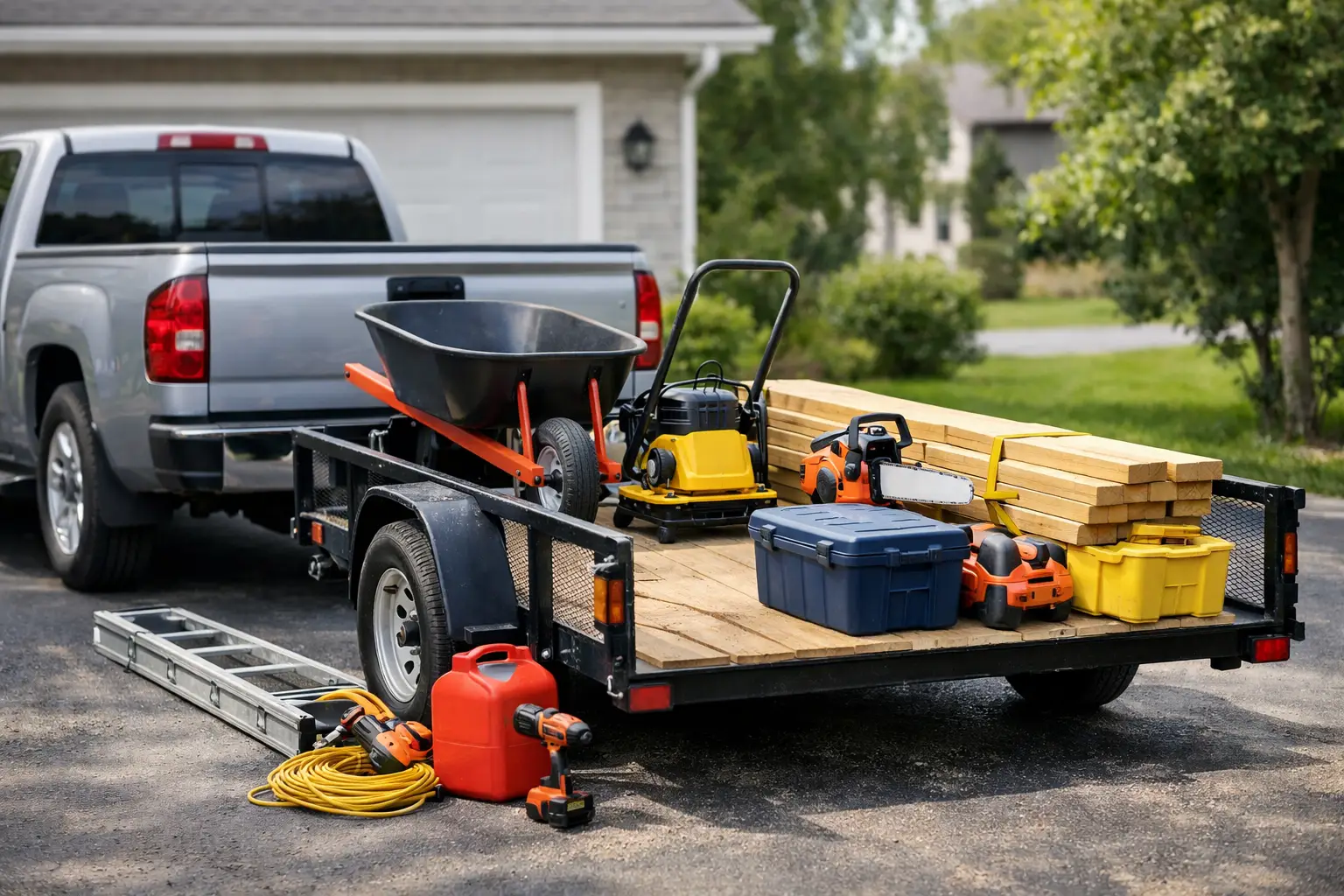

A load usually does not shift because of one big mistake. It shifts because of a few small ones stacked together – the wrong strap angle, too little tension, a worn hook, or a load that was never balanced right to begin with. That is why safe trailer tie down methods matter so much. They do more than protect what you are hauling. They help keep your trailer stable, your tow vehicle under control, and everyone else on the road out of danger.
If you rent a trailer for a weekend project, a vehicle move, or a jobsite run, tie-downs can feel like the part you figure out on the fly. That is where people get into trouble. A good trailer and a solid hitch setup are only part of the job. The load has to be secured in a way that matches its weight, shape, and how it can move under braking, turning, and rough pavement.
What safe trailer tie down methods really mean
At the most basic level, a tie-down system has one job: keep the load from moving forward, backward, side to side, or bouncing upward. Real-world hauling adds a few complications. Cargo shifts under braking. Suspension moves. Tires flex. Straps settle after the first few miles. What looked tight in the driveway may not stay that way once you hit a rough road.
That is why safe trailer tie down methods are not just about tightening a ratchet strap as hard as you can. They are about using the right equipment, placing it in the right spots, and creating restraint in more than one direction. A mower, side-by-side, couch, pallet of material, and passenger car all need a different approach.
The biggest mistake people make is treating every load the same. Light household items may do fine with properly placed straps over a stable load. Heavy equipment usually needs direct tie-down points on the machine itself. Vehicles need restraint that accounts for rolling movement and suspension travel. If the method does not match the cargo, the gear alone will not save you.
Start with the load before you touch a strap
Before you secure anything, look at three things: weight, balance, and anchor points. If the load is too far forward or too far back, no strap setup will fully fix the towing problems that follow. Poor balance can lead to sway, light steering, or trailer bounce. The cargo should sit in a position that gives proper tongue weight while still allowing room to secure it correctly.
Next, identify where the load is actually meant to be tied down. Strong tie-down points are not always obvious. On equipment, use manufacturer-approved securement points when available. On vehicles, avoid fragile suspension parts, brake lines, and components that were never designed to take a side load from a strap or chain.
Finally, think through how the item wants to move. A car wants to roll. A stack of lumber may slide. A tall tool chest may tip. A compact tractor can bounce and shift under its own weight. Once you know the likely movement, you can secure against it instead of guessing.
Straps, chains, and working load limits
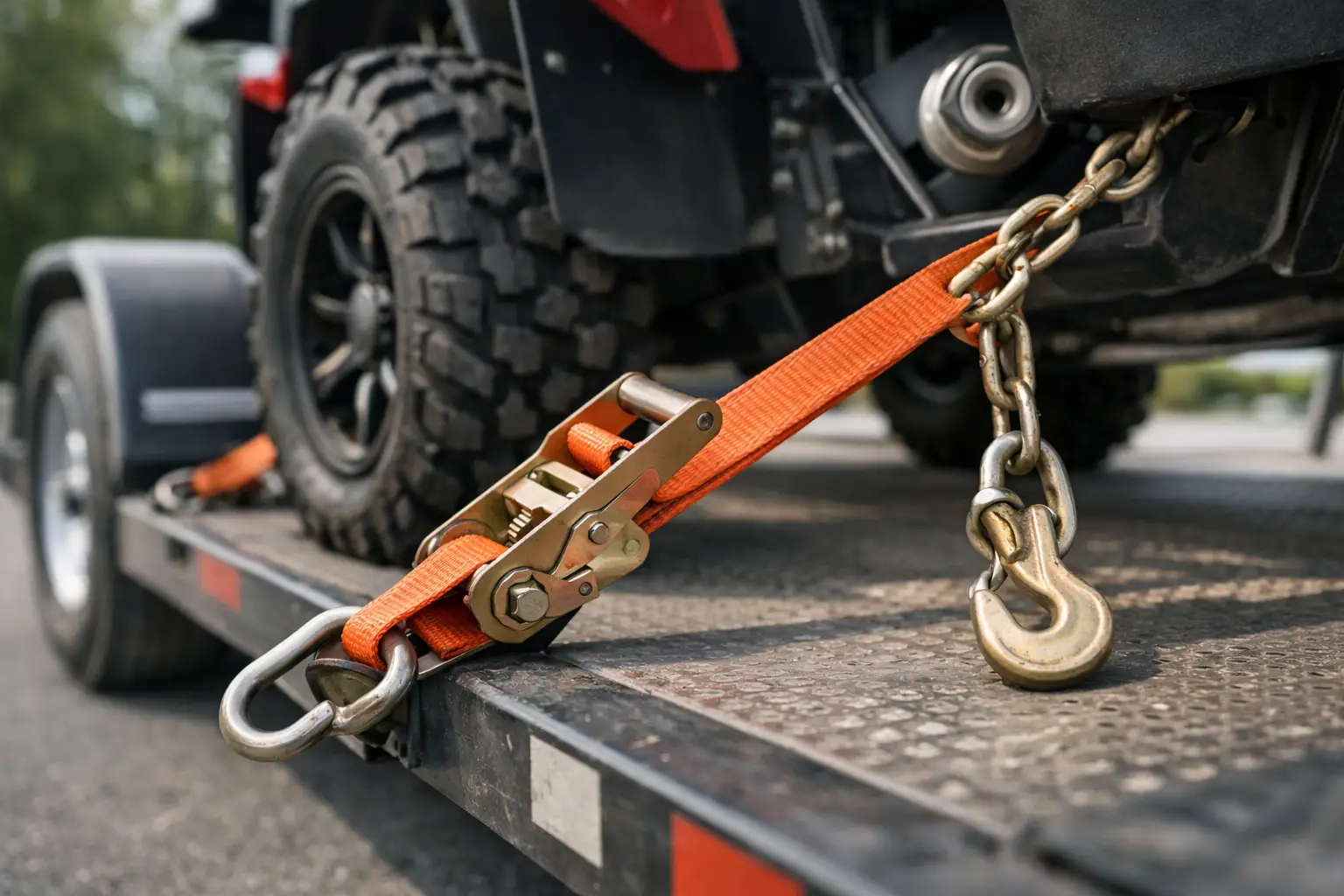
Not every tie-down belongs on every trailer. Ratchet straps are common because they are fast, adjustable, and easy to use, but they are not a one-size-fits-all answer. Heavy machinery may call for chains and binders. Lighter cargo may be fine with straps if the rating is right and the edges are protected.
The number that matters is the working load limit, not just the breaking strength printed on the label. Working load limit is the amount the tie-down is designed to handle in normal use. If your cargo weighs more than your securement setup can control, you are under-secured even if everything looks tight.
Condition matters too. A faded, cut, frayed, or oil-soaked strap should not be trusted. Bent hooks, cracked ratchets, and stretched chain links are warning signs, not minor issues. Tie-down gear is one of those things that can look mostly okay right up until it fails.
How to secure equipment and general cargo
For most equipment and material loads, the safest approach is usually direct securement. That means attaching tie-downs from the trailer to solid points on the cargo itself so the cargo cannot shift independently. Crossing the front pair and the rear pair can help control side-to-side movement, but it depends on the trailer layout and tie-down points available.
Strap angle matters more than many people realize. If a strap goes almost straight down, it may do a good job preventing bounce but not much to stop forward or rearward movement. If it runs too flat, it may pull sideways well enough but provide less downward hold. Good securement usually comes from a balanced angle that controls multiple directions at once.
For loads like appliances, furniture, or boxed materials, containment matters too. Place heavier pieces low and centered. Keep the load tight together so individual items cannot build momentum. Use straps to compress and stabilize, not just to pin one corner and hope the rest follows along.
A tarp is not a tie-down. It keeps weather and debris under control, but it does not replace proper securement.
Safe trailer tie down methods for cars and rolling vehicles
Vehicle hauling deserves extra attention because cars, trucks, and off-road vehicles are heavy, mobile loads. They are built to roll and their suspension is designed to move, which changes how they behave on a trailer.
One common method is securing the vehicle by the tires using wheel nets or tire straps. This is often a solid option because it holds the vehicle without pulling against delicate underbody parts. It also allows the suspension to move naturally while the tires stay planted to the trailer.
Another method is direct frame or axle securement, but this has to be done carefully. Incorrect attachment points can damage components or create an unstable hold. If you are using axle straps, make sure they are placed on appropriate solid points and kept clear of brake lines, steering parts, and sharp edges.
No matter the method, a vehicle should be secured so it cannot roll in either direction or walk sideways on the deck. Parking brake use can help, but it should not be your only restraint. The tie-down system is what keeps the load in place.
On a car hauler, it is also worth rechecking strap tension shortly after departure. Vehicle tires can settle into the deck and straps can loosen slightly in the first few miles.
Common mistakes that cause problems fast
Most bad securement jobs have the same weak spots. Too few tie-downs is one. So is attaching to poor anchor points because they are easy to reach. Another common mistake is running straps over sharp metal edges without protection, which can cut a strap much faster than people expect.
Over-tightening can be a problem too, especially on lighter cargo or where straps are routed around parts that can bend or crack. Tight enough to secure is the goal. Cranked down until something is stressed or deformed is not better.
Loose ends matter. Strap tails whipping in the wind can fray, distract other drivers, or get caught where they should not. Twisted straps are another issue. A twist might seem harmless, but flat webbing generally performs better and wears more evenly.
Then there is the skip-the-recheck mistake. A secure load at the start is only the starting point. After a few miles, stop and inspect. Then check again on longer trips, especially after rough roads, steep grades, or hard braking.
A practical tie-down routine before you hit the road
A simple routine beats guesswork every time. Load the trailer so the weight is balanced and the cargo sits where it should. Attach tie-downs to real anchor points on both the trailer and the load. Tighten them evenly so one strap is not doing all the work. Check clearances around tires, fenders, suspension parts, and edges that could cut webbing.
Then do a walk-around with one question in mind: if you slammed the brakes, turned hard, or hit a pothole, where would this load try to go? If you cannot answer that confidently, look again before you leave.
If you are renting a trailer and you are not sure which securement method fits your load, ask before you pull out. A good local rental outfit should be able to tell you whether you need heavier tie-downs, different anchor points, or a better trailer choice for the job. That kind of straight answer saves time and prevents roadside problems.
When the safest move is changing the plan
Sometimes the issue is not the strap setup. It is the load itself. If cargo is too tall, top-heavy, oddly shaped, or lacks proper tie-down points, the safest move may be repositioning it, reducing the load, or using a different trailer. The same goes for oversized equipment that technically fits the deck but leaves no room for proper securement angles.
That is not overthinking it. It is the kind of call that keeps a simple haul from turning into a bad day.
Good hauling is usually quiet and uneventful, and that is exactly the point. When your load is balanced, your tie-downs are rated and placed correctly, and you take the time to recheck them, the trip feels boring in the best possible way. That is what you want every time you pull out onto the road.