
Most people asking what size trailer do I need are really asking two things at once: will my load fit, and will my vehicle handle it safely? Both matter. A trailer that is too small wastes time and creates tie-down headaches, but one that is too large can be harder to tow, harder to load, and more expensive than you need.
The right choice comes down to a few practical details: what you are hauling, how much it weighs, how it needs to be loaded, and what your tow vehicle is rated for. If you get those four things right, picking a trailer gets a whole lot easier.
What size trailer do I need for my job?
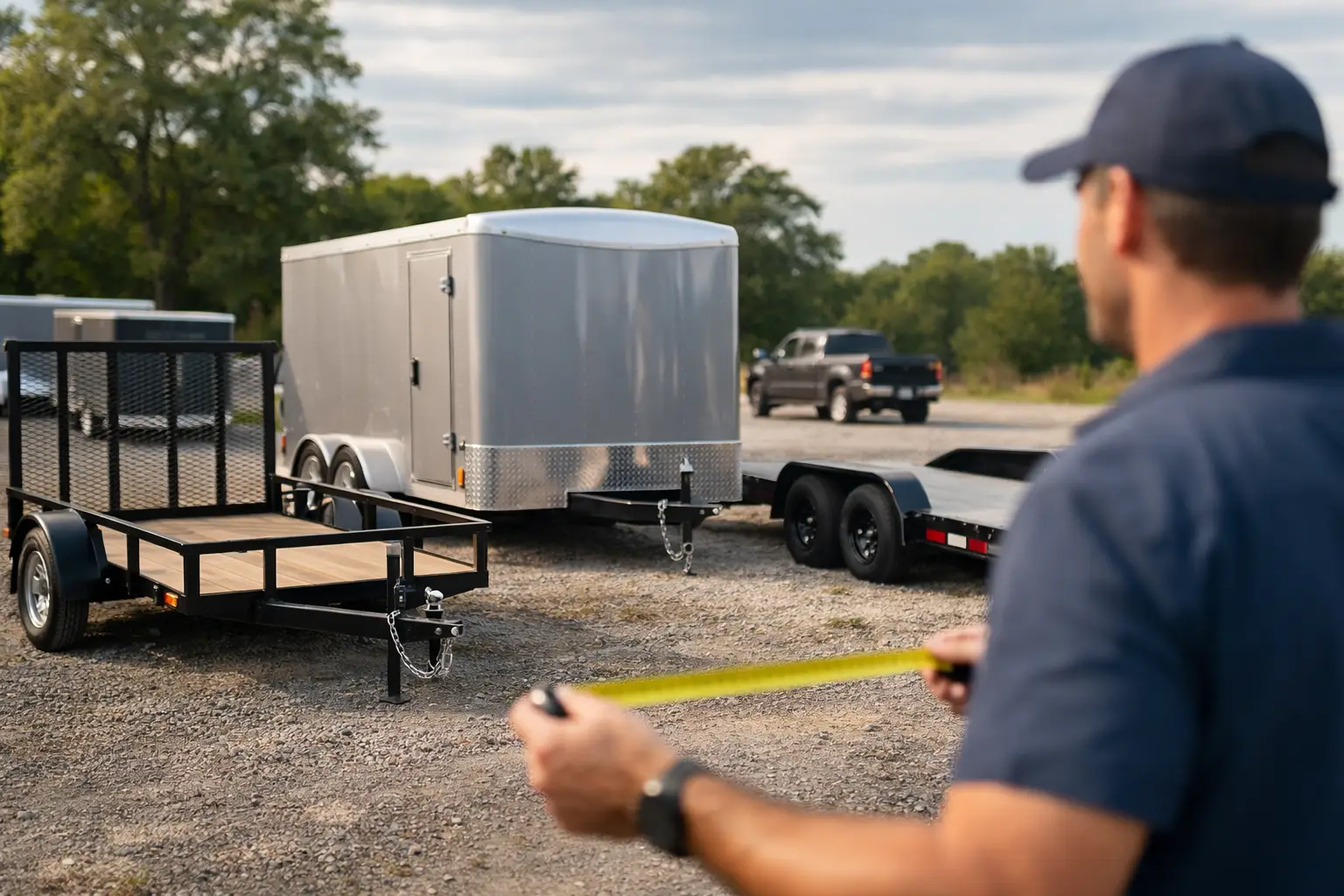
Start with the cargo, not the trailer. Measure the longest, widest, and tallest part of what you need to move. Then think about how the item actually sits when loaded. A riding mower, for example, may fit on paper, but once you account for the mower deck, ramp angle, and room to walk around it for tie-downs, a tight fit becomes a bad fit.
Weight is just as important as length and width. Many first-time renters focus on deck space and forget capacity. A trailer can have enough room for your load and still be the wrong choice if the combined weight of the cargo exceeds the trailer’s rating or pushes your vehicle past its towing limit.
You also want a little breathing room. If your load barely fits from rail to rail or from front to back, loading becomes slow and frustrating. In most cases, having some extra deck space makes the job easier and safer, especially if you need to shift the load for proper tongue weight.
The three measurements that matter most
When people shop for a trailer, they usually look at length first. That makes sense, but length alone does not tell the whole story.
Deck length
Deck length tells you how much usable floor space you have from front to back. For furniture, appliances, UTVs, lawn equipment, and building materials, this is usually the first limiting factor. If you are hauling something with ramps or attachments, include those in your measurement.
Deck width
Width can become the deciding factor faster than people expect. Side-by-sides, pallets, zero-turn mowers, and some small tractors may be too wide for a narrow utility trailer even if the length looks fine. Wheel wells can also reduce usable space on certain trailer styles, so it helps to know whether you need full-width loading.
Payload capacity
Payload capacity is the amount of cargo the trailer can carry, separate from the trailer’s own weight. This is where people get into trouble with gravel, dirt, pavers, equipment, and vehicles. A lighter trailer might work fine for yard waste and household items, but dense materials add up fast.
If you are hauling a vehicle, use the vehicle’s curb weight, not a guess. If you are hauling materials, estimate by the cubic yard or by item count. It is always better to be conservative than to learn mid-load that you are over capacity.
Common trailer sizes and what they usually fit
There is no perfect one-size-fits-all answer, but a few common trailer sizes cover most local hauling jobs.
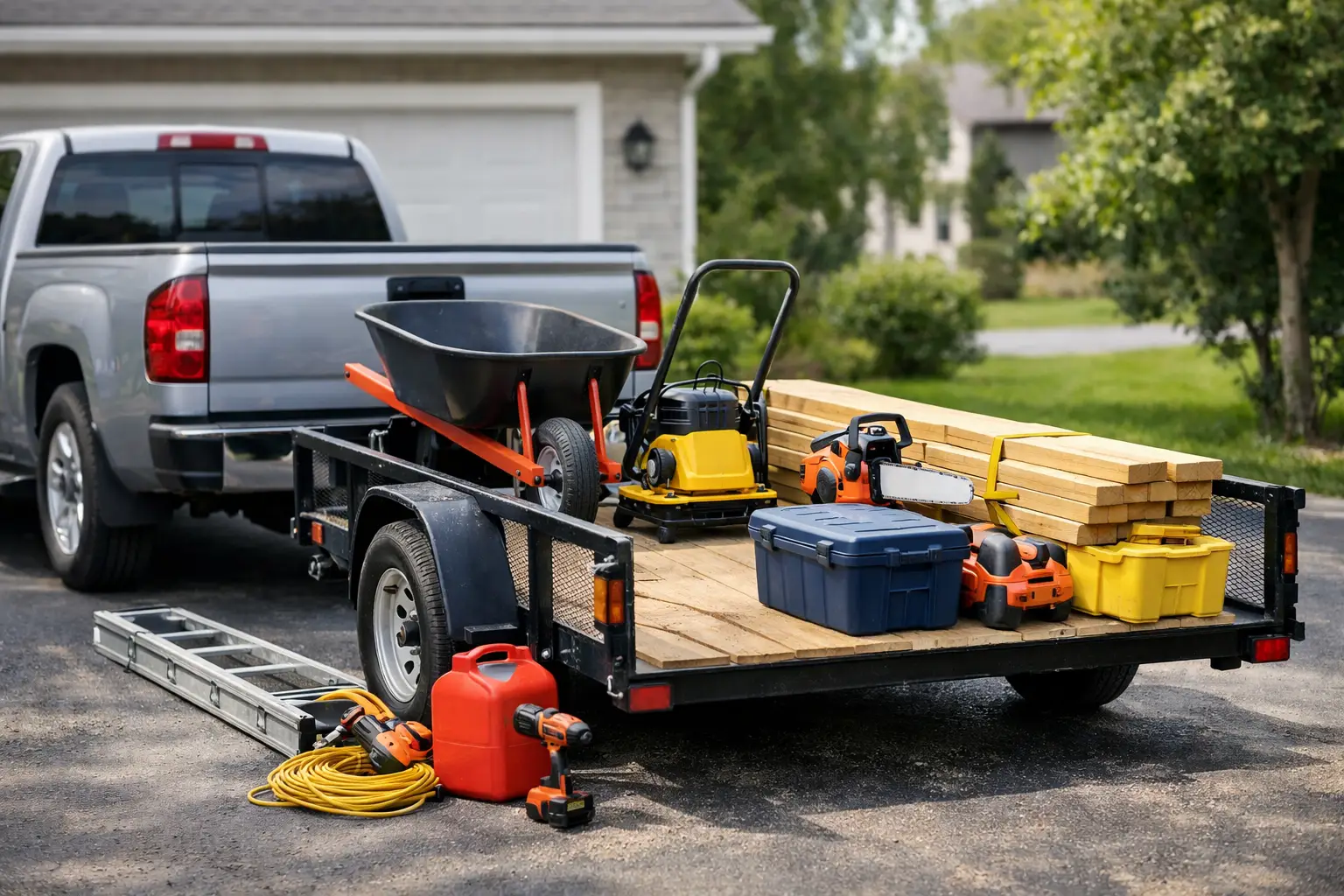
A 5×8 or 5×10 utility trailer is often enough for small home projects, yard cleanup, boxes, light furniture, and a push mower or small ATV. It is easy to tow and a good fit when space is limited and the load is relatively light.
A 6×10 or 6×12 trailer gives you more flexibility for appliances, renovation debris, small landscaping jobs, and larger equipment like a riding mower. For many homeowners, this is the sweet spot because it handles more than a small trailer without becoming awkward to maneuver.
A 7×14 or 7×16 trailer makes sense when you are moving heavier equipment, multiple pallets of material, or bulkier loads that need room to balance correctly. Contractors and frequent haulers often prefer this range because it covers a wide variety of jobs.
If you are moving a car, SUV, or light truck, a dedicated car hauler is usually the right answer. Vehicle transport is not just about deck length. You need the right ramps, tie-down points, and capacity. That is why a true car hauler is a better fit than trying to make a basic utility trailer work for a job it was not designed to do.
What size trailer do I need for a car?
For a passenger car, crossover, or small SUV, the trailer needs to be long enough for the wheelbase and overall vehicle length, wide enough for the track width, and rated for the full vehicle weight. It also needs the right loading setup.
That last part matters. A vehicle may technically fit on a trailer, but if the ramps are wrong, the deck height is not suited for loading, or you cannot position the car to get safe tongue weight, it is not the right trailer. Car hauling is one of those jobs where close enough is not good enough.
If you are transporting a low-clearance car, loading angle matters too. Sports cars and some sedans can scrape on steep ramps. If you are hauling a truck or SUV, weight capacity becomes the bigger issue. In both cases, the smartest move is to match the trailer to the specific vehicle rather than assume any flat trailer will do.
Match the trailer to your tow vehicle
Even the right trailer for the cargo can be the wrong trailer for your truck or SUV. Check your owner’s manual or tow rating sticker before you book anything. You need to know your maximum towing capacity and, ideally, your payload limits too.
Keep in mind that the trailer’s empty weight counts. So does the cargo. So do tools, fuel, passengers, and anything else riding in the tow vehicle. This is where people accidentally overload a midsize SUV or half-ton truck without realizing it.
Braking is part of the equation as well. A heavier trailer may require trailer brakes and the right connector setup. If your load is on the upper end of what your vehicle can tow, that is not the time to wing it. Safer towing usually means leaving yourself a margin instead of maxing everything out.
A few real-world examples
If you are cleaning out a garage in Cottonwood and hauling old shelving, boxes, and a few appliances to the dump, you probably do not need a large equipment trailer. A mid-size utility trailer is often enough, and it is easier to back into a driveway.
If you are a landscaper moving a zero-turn mower, trimmer racks, and a few extra tools between jobs, a small trailer may feel cramped every single time you load it. Going one size up can save time and reduce frustration.
If you are moving a project car across the Verde Valley, trailer size is only half the decision. The right car hauler gives you proper support, loading, and tie-down options so the job gets done safely.
When to size up and when not to
Sometimes going bigger is the right call. If the load is awkward, if you need room to reposition weight, or if you will be making multiple stops with mixed cargo, extra deck space helps.
But bigger is not always better. A larger trailer can be harder to park, harder to reverse, and less forgiving on narrow roads or tight driveways. It may also cost more and put more demand on your tow vehicle. If your job is simple and your load is light, a smaller trailer can be the better tool.
The best choice is usually the smallest trailer that safely fits the load, carries the weight, and gives you enough room to secure everything properly.
The easiest way to get it right
If you know the cargo dimensions, the estimated weight, and what you are towing with, you are already most of the way there. From there, the rest is about matching the trailer to the job instead of guessing.
That is where talking to a local rental company helps. A team that actually picks up the phone can save you from renting too small, paying for too much trailer, or showing up with a tow vehicle that is not set up for the load. If you are booking through Monsoon Trailer Rental, having those details ready makes it faster to point you toward the right fit.
A good trailer should make the job easier, not add stress to it. If you are on the fence between two sizes, think less about what barely works and more about what lets you load, secure, tow, and unload without fighting the equipment the whole way.
Pingback: Contactless Trailer Rental That Still Feels Local – Monsoon Trailer Rental LLC
Pingback: How to Load a Rental Trailer Safely - Monsoon Trailer Rental LLC
Pingback: How to Load Landscaping Equipment Safely - Monsoon Trailer Rental LLC