
If you are asking what trailer works for ATVs, the honest answer is this: the right trailer depends on how many machines you are hauling, how far you are going, and what your tow vehicle can safely handle. A single ATV headed across town is one thing. Two bigger machines, gear, and a rougher route through northern Arizona is another.
Most people do not need the biggest trailer on the lot. They need the one that loads easily, rides steady, and gives them enough room to tie down the ATV without turning a simple haul into a wrestling match. That usually means paying attention to deck size, payload capacity, ramp style, and trailer weight before anything else.
What trailer works for ATVs in real use?
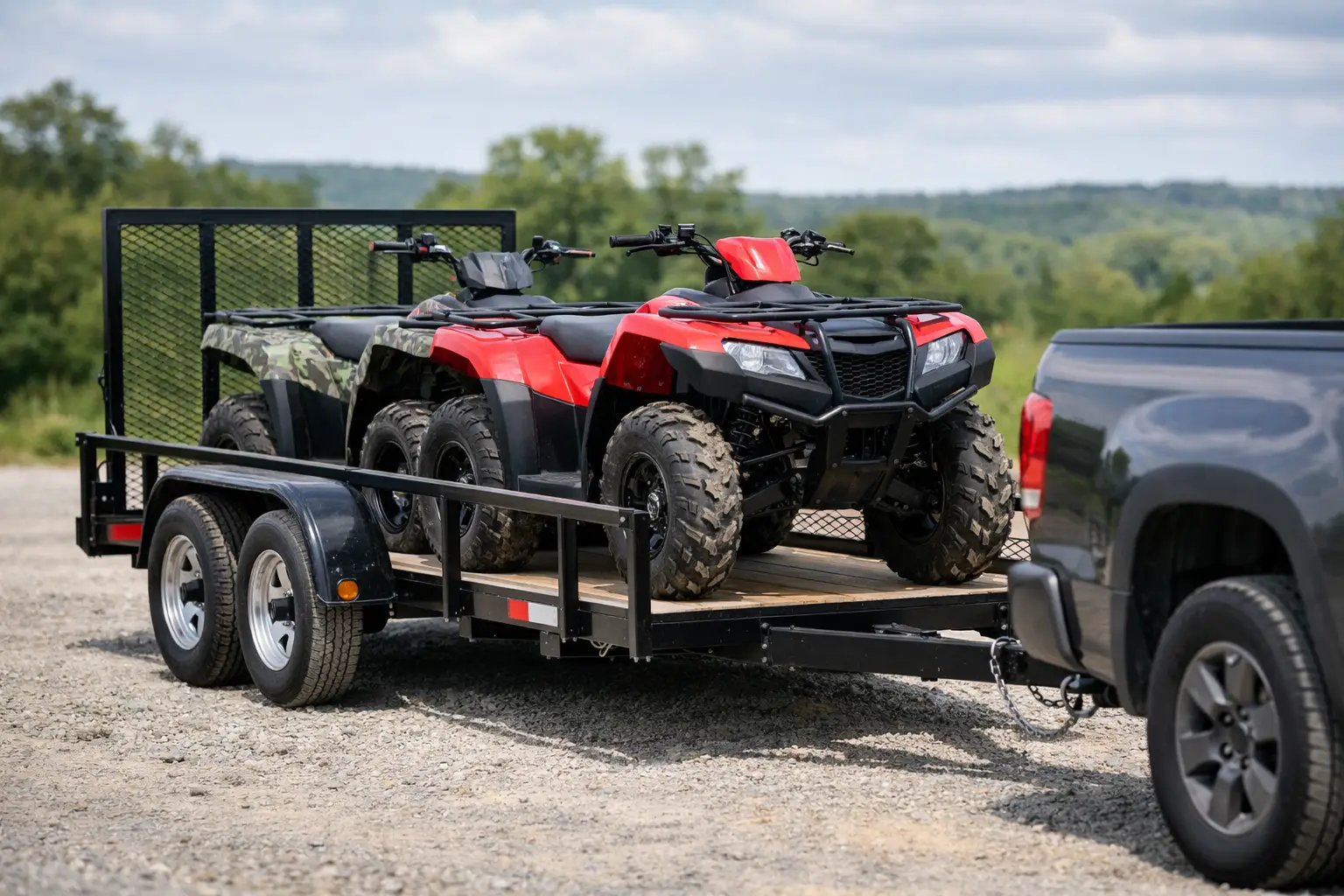
For most ATV hauling jobs, an open utility trailer is the practical choice. It is easier to load, usually lighter than an enclosed trailer, and gives you flexibility if your machine is muddy, wider than expected, or carrying extra gear. If you are hauling one ATV, a smaller utility trailer often gets the job done. If you are hauling two ATVs or one larger side-by-side style machine, you need to step up in size and weight capacity.
The mistake people make is choosing based on deck length alone. Length matters, but width and payload matter just as much. An ATV trailer has to fit the machine with enough room to position it correctly over the axle and still have space for tie-down points to work the way they should.
A trailer that is technically long enough but too narrow can be more trouble than a trailer that looks slightly oversized. With ATVs, loading angle and tire placement matter. You want the machine centered and stable, not squeezed in with inches to spare.
Start with the ATV, not the trailer
Before picking a trailer, know three numbers: your ATV’s curb weight, overall length, and overall width. If you are hauling more than one machine, add the total weight together and include fuel, coolers, tools, ramps, and anything else riding with it.
A lot of ATV owners underestimate total hauling weight because the machine itself does not seem that heavy. But once you add a second ATV, a spare gas can, riding gear, and a trailer tongue box or loose equipment, the load climbs fast. The trailer has to carry that weight, and your tow vehicle has to stop it.
If your ATV is outfitted with aftermarket tires, racks, or accessories, do not assume factory dimensions still apply. Wider tires and front bumpers can change how well the machine fits between rails or through a gate.
Trailer size that usually makes sense
For one standard ATV, a 5×8 or 5×10 utility trailer can work if the machine fits comfortably and the trailer has the right payload rating. A 6×10 gives more breathing room and is often the safer bet if you want easier loading and tie-down access.
For two ATVs, many people are better off with at least a 6×12 or larger trailer, depending on machine size. If the ATVs are larger utility models instead of smaller sport models, you may need more deck space than you expect. Tight loading leaves less room to balance the weight and secure each machine properly.
That is why the answer to what trailer works for ATVs is rarely one exact size. A small sport ATV and a larger 4×4 utility ATV do not have the same trailer needs. The right fit is the one that gives you enough deck space without pushing your tow vehicle beyond its limits.
Pay close attention to payload capacity
This is where good decisions get made. Payload capacity is the amount of weight the trailer can carry, not the total weight of the trailer itself. If a trailer weighs 1,000 pounds and has a gross vehicle weight rating of 2,990 pounds, your usable payload is about 1,990 pounds.
That number has to cover the ATV, your gear, fuel, and anything else on the deck. If you are close to the limit on paper, you are too close in real life. A little extra capacity gives you a safer margin and a better towing experience.
Overloading a trailer does not just wear equipment out. It can make the trailer sway more, reduce braking performance, and stress tires, bearings, and suspension components. For a short local trip, people are tempted to shrug that off. That is exactly when avoidable problems happen.
Ramps matter more than people think
A trailer for ATVs should be easy to load without drama. A built-in ramp gate is convenient because it is always there and quick to use. For many ATV owners, that is the simplest option. The trade-off is that a ramp gate adds wind resistance and can affect fuel mileage while towing.
Slide-in or separate ramps can reduce drag, but they require more setup and storage. They also have to match the machine’s width and weight. If the ramps are too narrow, too steep, or awkward to position, loading gets sketchy fast.
Low deck height is a real advantage with ATVs. The lower the trailer sits, the less severe the loading angle. That matters if your machine has low clearance, long racks, or if you are loading on uneven ground. For driveways, dirt lots, and job sites around the Verde Valley, a forgiving loading angle is worth a lot.
Open trailer or enclosed trailer?
For most local ATV hauling, open trailers make more sense. They are lighter, simpler, and easier to inspect while towing. They are also usually less expensive to rent and easier to maneuver.
An enclosed trailer can be a good option if you want weather protection, security, or room for extra equipment. But it adds trailer weight, catches more wind, and demands more from the tow vehicle. If all you need is to move an ATV to a trailhead, shop, property, or work site, enclosed is often more trailer than necessary.
There are cases where enclosed is the right call. If your ATV is high-value, you are hauling expensive tools with it, or you need protection from dust and weather on a longer trip, the extra weight may be worth it. But for straightforward hauling, open utility trailers are usually the better fit.
Tie-down points are not optional
A trailer can be the right size and still be wrong for ATVs if it does not give you solid tie-down locations. You want secure anchor points that let you strap the ATV down from the front and rear without awkward angles.
Good tie-down placement helps you keep the machine stable and centered. It also saves time. If you have to improvise every strap location, loading becomes slower and less secure than it should be.
Wheel chocks are helpful but not a substitute for proper straps. The ATV should be tied down with quality ratchet straps rated for the load, and the suspension should be compressed enough to limit bounce without overdoing it.
Match the trailer to your tow vehicle
A trailer that works for ATVs still has to work with your truck, SUV, or crossover. Check your vehicle’s towing capacity, hitch rating, trailer connector, and brake requirements before you book anything.
This is where people get tripped up. A trailer may be perfect for the ATV but too heavy once loaded for the vehicle pulling it. Or the tow vehicle may have enough towing capacity but not enough payload for passengers and gear on top of tongue weight.
If you are towing with a smaller SUV, a lighter open utility trailer is often the smarter route. If you have a half-ton truck, you have more flexibility. Either way, matching the whole setup matters more than just making the ATV fit on the deck.
What first-time renters should look for
If this is your first time renting a trailer for an ATV, keep it simple. Ask for a trailer with a little more room than the bare minimum, a practical ramp setup, and enough capacity to handle the load without cutting it close.
It also helps to work with a local rental company that will actually answer questions instead of handing you keys and sending you on your way. A straightforward conversation about what you are hauling, what you are towing with, and where you are headed can save you from renting the wrong trailer.
At Monsoon Trailer Rental, that is usually how the best rentals get matched – not with guesswork, but with a quick real-world look at the job.
The best trailer is the one that makes the haul easy
If you are still wondering what trailer works for ATVs, think in terms of fit, not just size. You want enough deck space, enough payload, an easy loading angle, and tie-down points that make sense. Bigger is not always better, and cheaper is not always cheaper if the wrong trailer turns the trip into a problem.
A good ATV trailer should feel boring in the best way. It loads without a fight, tracks straight, and gets your machine there without you second-guessing every mile. That is the kind of haul worth booking.